
Fuji Oil Group’s Sustainability Management
Sustainability Management
Sustainability Areas
Priority Actions
- OverviewStrategy Management
- Governance
- StrategyMaterial ESG issues
- Risk Management
- Metrics and Targets
Fuji Oil Group’s sustainability strategyGRI:2-22, 2-23
The Fuji Oil Group’s DNA and sustainability
Ever since our company was founded, the Fuji Oil Group has specialized in plant-based ingredients, centered around tropical oils and fats and soy protein, and our business has always been built on a spirit of challenge and innovation. As a B2B manufacturer of food ingredients, we are committed to addressing the challenges and concerns of our customers and wider society, creating value through solutions to these issues. This is in the very DNA of our Group.
This problem-solving approach and our efforts to explore the potential of plant-based ingredients form the foundation of our business, as we work to provide healthy and delicious foods in response to diversifying needs, bringing new value to society.
Our initiatives to create value extend to tackling environmental and social issues across the whole food value chain, from raw material procurement to product supply. To us, sustainability is more than a matter of social contribution. Sustainability is at the core of our management philosophy, supporting continuous improvement in corporate value, and forming the starting point for sustainability management.
Emerging social issues and changing customer needs
In today’s world, as well as ever greater natural risks such as climate change, deforestation, and biodiversity loss, we are facing complex social issues like limited resources and human rights issues in regions where raw materials are produced. These issues affect the whole value chain, from production of raw materials through procurement and manufacturing to sales, and are changing the very conditions that underpin our business activities.
Growing geopolitical risks and fluctuating commodity prices are further increasing uncertainty in raw material procurement. As a manufacturer of food ingredients, we are particularly reliant on agricultural produce. Climate change and other environmental changes are manifested as instability in the supply of raw materials, which means that ensuring stable procurement is an important management challenge for us.
Meanwhile, as the global population rises, with aging societies and more diversity in values, there is growing interest in physical health and mental well-being through diet. We are entering a new era where consumers require food that is delicious, healthy, and sustainable, all at the same time. These changes show that people are questioning what sustainable food really means.
Against this backdrop, in addition to tackling environmental challenges such as carbon neutrality, nature-positive initiatives, and the transition to a circular economy, there are strong calls for companies to ensure traceability and to implement procurement practices that are environmentally responsible and respect human rights. Responsible sourcing of raw materials is no longer a matter of competitive advantage; it is becoming an essential prerequisite for business continuity.
These changes are also affecting the value that our customers expect from us. In addition to ensuring food safety, which has always been required, there are increasing demands for a stable supply of food ingredients produced with environmental and social sustainability in mind.
Value creation with solutions connecting the entire value chain
In today’s rapidly changing business environment, our Group aims to address social issues in the value chain at the same time as achieving sustainable growth. We are working to create value throughout the value chain, from sourcing raw materials to supplying products. Our current medium-term management plan provides a specific roadmap toward making this vision a reality. With sustainability at the core of our management, we are implementing measures based on three basic policies: Enhance governance, further strengthen growth fields, and Establish new business fields.
Our material ESG issues serve as a guide for medium- to long-term value creation. We have identified these material ESG issues based on the impact that our business activities have on society and the environment, and the financial impact on our Group of risks and opportunities stemming from social issues. Based on these material ESG issues, we are working on addressing issues at all stages of the value chain: from sustainable procurement in our upstream supply chain, to environmentally responsible MONOZUKURI (Product Development and Manufacturing Practices) and human capital and occupational safety at our Group, to food safety and health of people in society in the downstream value chain.
As a B2B manufacturer of food ingredients, we are identifying environmental and human rights risks and supply issues relating to raw materials in our upstream supply chain, and monitoring changing customer and consumer needs. For our main raw materials, we are strengthening collaboration with upstream suppliers to implement initiatives throughout the value chain. In this way, we are working to provide solutions connecting the entire value chain, from upstream to downstream.
As specific examples of our value creation initiatives addressing both quality and sustainability, we are enhancing our supply chain by promoting sustainable procurement; developing alternative oils and fats and products that do not use cocoa, in anticipation of future supply constraints; and creating upcycled products that both reduce environmental impact and contribute to circular use of resources. These initiatives reframe upstream risks as business opportunities, leading to creating economic value through solving social issues that lie behind customer and consumer needs. This embodies our Group’s problem-solving approach to business.
In the supply chain for palm oil, in particular, we are ensuring traceability, preventing deforestation and protecting biodiversity, advancing sustainable procurement that respects human rights, and working to reduce risks in the supply chain through our grievance mechanism.
By putting sustainability management into practice based on the material ESG issues, we will co-create value with our stakeholders to deliver both deliciousness and healthiness and a sustainable food value chain, aiming to create a sustainable future for food for the next generation.
Figure: Fuji Oil Group’s sustainability strategy

Image links to a PDF file(47KB)
Table: Connection between material ESG issues and key policies of the medium-term management plan

Image links to a PDF file(107KB)





Governance
Board of Directors and Sustainability CommitteeGRI:2-9,2-12,2-13,2-14,2-16,2-24,2-26,3-3
As a company with an Audit and Supervisory Committee, the Fuji Oil Group practices sustainability management under the supervisory function of the Board of Directors. The Group has established the Sustainability Committee*1 as an advisory body to the Board of Directors to regularly deliberate on and monitor sustainability-related risks and opportunities. The committee meets at least twice a year in accordance with the Sustainability Committee Rules, and its deliberations and recommendations are reported to the Board of Directors. The Board of Directors*2 uses this information to determine the direction of the Group’s medium- to long-term management and key initiatives.
The committee is chaired by the President and Chief Executive Officer (CEO), and is composed of the Chief Operating Officer (COO), the Chief Financial Officer (CFO), and the heads of each business and functional headquarters, forming a structure with tightly integrated management and executive functions. Additionally, outside directors participate as ESG Advisors, along with experts who are not part of the committee, to share their expertise and give objective advice as needed. This strengthens alignment between our management strategies and material ESG issues, while enabling highly effective discussions that incorporate outside perspectives.
This governance system enables the Group to identify and review material ESG issues, aiming to address environmental and social issues while enhancing corporate value in an integrated manner. The committee also examines increasingly diverse and complex sustainability issues from the medium- to long-term perspective and regularly monitors the progress of initiatives linked to the Group’s business activities.
- *1 Established in 2015, the ESG Committee was renamed in May 2022 to clarify its role in relation to the Board of Directors, which is responsible for corporate governance.
-
*2 Appointed directors with extensive knowledge of sustainability. Through executive training, the board is building the knowledge and expertise needed to ensure its monitoring function from an ESG perspective.
Corporate Governance System
https://www.fujioil.co.jp/en/about/governance/system/
Table: Sustainability Committee: Matters deliberated in FY2025
| Date of meeting | Matters for deliberation by the Sustainability Committee | Example recommendations and reports to the Board |
|---|---|---|
| First April 2025 |
|
|
| Second October 2025 |
|
|
| Third December 2025 |
|
Outside directors and external experts serve as advisors to the Sustainability Committee and provide input and advice, which are used to improve initiatives on material ESG issues and Sustainability Committee operations.
For specific feedback from the advisors, please refer to “Expectations from our stakeholders.”
-
Stakeholder Engagement > Expectations from our stakeholders
https://www.fujioil.co.jp/en/sustainability/stakeholder_engagement/#topic03
Figure: The function of the Sustainability Committee (FY2026)
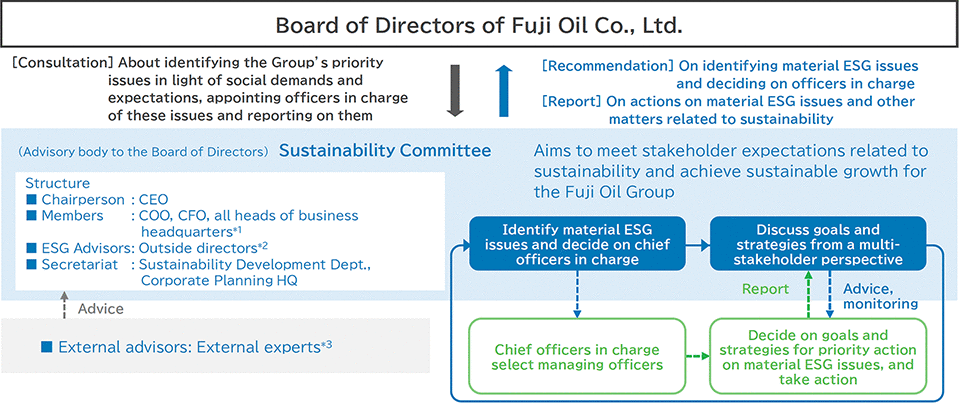
Image links to a PDF file(169KB)
- *1 Head of Corporate Planning HQ, Head of Finance and Accounting HQ and Human Resources & Administration HQ, Head of Safety, Quality and Production Technology HQ, Head of R&D HQ, Head of Oils & Fats Business HQ, Head of Chocolate Business HQ, Head of Emulsified & Fermented Ingredients Business HQ, Head of Soy Ingredients Business HQ
- *2 Rie Nakagawa, Yasuhiro Tani
- *3 Ogi Kanaya, BSR Associate Director
IncentivesGRI:2-19
Executive remuneration (performance-linked cash remuneration) related to ESG
Following our transition to an business holding company structure in April 2025, we revised the executive remuneration system effective FY2025. This revision, following discussions within the Nomination and Compensation Advisory Committee, aims to clarify the roles and responsibilities expected of each director and executive officer, and to shift to an incentive-based system that encourages them to contribute to corporate growth from their respective positions.
The new system sets non-financial common KPIs linked to material ESG issues as indicators for the performance evaluation of both directors and executive officers. This framework incentivizes actions that better meet stakeholder expectations for greater corporate value.
For FY2025, non-financial KPIs were set based on the employee engagement score (company-wide overall score), with a 10% evaluation weight for both directors and executive officers. The setting and evaluation of KPIs are reviewed by the Nomination and Compensation Advisory Committee.
Fuji Oil Co., Ltd. also established guidelines for setting management-aligned goals in its managerial program in FY2022. Following these guidelines, targets are set not only for short-term profits but also for non-financial areas outlined in the medium-term management plan, such as human capital and other sustainability-related matters. These and other performance targets are appropriately weighted and included in evaluations.
Company awards: ESG Award / Sustainability Special AwardGRI:2-24
The Fuji Oil Group established the ESG Award in FY2017 to recognize Group companies and departments that have contributed to sustainability management. By recognizing and awarding sustainability-related initiatives, the management aims to raise awareness and further deepen sustainability practices across the Group. Along with other company awards, ESG Award recipients are selected by a selection committee composed of internal directors, based on nominations from related specialized departments, and are then approved by the Management Committee Meeting.
For FY2025, the ESG Award went to PT. Freyabadi Indotama (Indonesia) and Fuji Oil (Zhang Jia Gang) Co., Ltd. (China) for achieving safe, high-quality production while lowering environmental impact. Both companies were highly evaluated for their significant efforts in advancing our ESG management. These included steady reductions in CO2 emissions, water use, and waste intensity through energy conservation and circular production, as well as recording zero workplace accidents and reducing incidents and complaints through initiatives involving all employees.
Furthermore, in the same fiscal year, Fuji Oil Co., Ltd.’s Soy Ingredients Business Headquarters received the Special Award for Sustainability. The headquarters was recognized for its sale of SoyBio MA, a purification agent made by upcycling soy whey, a byproduct of its manufacturing process. This initiative contributes to environmental conservation through the remediation of contaminated soil and groundwater, while also promoting resource recycling and increasing business profits.
Through these award programs, the Group actively recognizes outstanding initiatives grounded in the philosophy of sustainability management and shares them within the Group to encourage value creation led by people on the front lines of our operations. We will continue to drive sustainable business growth by further expanding initiatives that enhance both social and economic value.
Strategy
Risks and opportunities in the value chainGRI:2-6,3-1,3-3
The Fuji Oil Group is a diverse food ingredient manufacturer that operates globally with four business segments: Vegetable Oils and Fats Business, Chocolate Business, Emulsified and Fermented Ingredients Business, and Soy Ingredients Business. Our customers span a wide range of industries, from food manufacturers to restaurants and retailers. Our food value chains are diverse and complex, extending across various regions and businesses — from raw material production and procurement to processing, manufacturing, consumption, and disposal. A wide variety of social issues can be found across these value chains, including environmental and human rights concerns.
In light of the nature of its business, the Group identifies material sustainability matters from the perspective of dependencies and impacts, as well as from risks and opportunities, to define its material ESG issues. Notably, we see that material issues that could impact our business continuity are concentrated in the production regions of our major raw materials, which are agricultural products. These material issues include climate change, ecological shifts, biodiversity loss, and human rights issues.
While these issues represent risk factors such as unstable raw material supply and rising costs, they could also lead to new business opportunities, including the development of more sustainable procurement and alternative ingredients. Our Group takes an integrated approach to these risks and opportunities, linking initiatives addressing material ESG issues to our business strategy, aiming to both create positive impacts and reduce negative impacts with the ultimate goal of increasing corporate value.
Going forward, we will continue to use our understanding of the challenges facing our entire value chain as a key to transforming our environmental and social actions into a source of competitive advantage, with the goal of creating sustainable food value chains and achieving medium- to long-term growth.
For details on our strategies per sustainability area (approach, risks and opportunities, financial impact, related value chain, vision/goal, environmental/social impact, and relevance to business), see the strategy matrix of each sustainability area listed below.
- Food Safety and Health > Strategy
https://www.fujioil.co.jp/en/sustainability/safety_and_health/#strategy - Environmentally Responsible MONOZUKURI > Strategy
https://www.fujioil.co.jp/en/sustainability/environmentally_responsible/#strategy - Sustainable Procurement > Strategy
https://www.fujioil.co.jp/en/sustainability/sustainable_procurement/#strategy - Human Capital and Occupational Safety > Strategy
https://www.fujioil.co.jp/en/sustainability/humancapital/#strategy - Fair Business Conduct / Information Security > Strategy
https://www.fujioil.co.jp/en/sustainability/corporate_activities/#strategy
Connection between risks/opportunities in the value chain and our material ESG issues
Our Group systematically organizes the material sustainability matters across its value chains, defining them as six areas: Food Safety and Health, Environmentally Responsible MONOZUKURI (Product Development and Manufacturing Practices), Sustainable Procurement, Human Capital and Occupational Safety, Information Security, and Fair Business Conduct.
In these areas, we identified 20 priority actions for our material ESG issues.
The Group aims to increase both social and economic value by placing these material ESG issues at the center of its operations and undertaking business-linked initiatives, thereby reducing risks and creating business opportunities across our value chains.
Figure: Material sustainability matters in the value chain
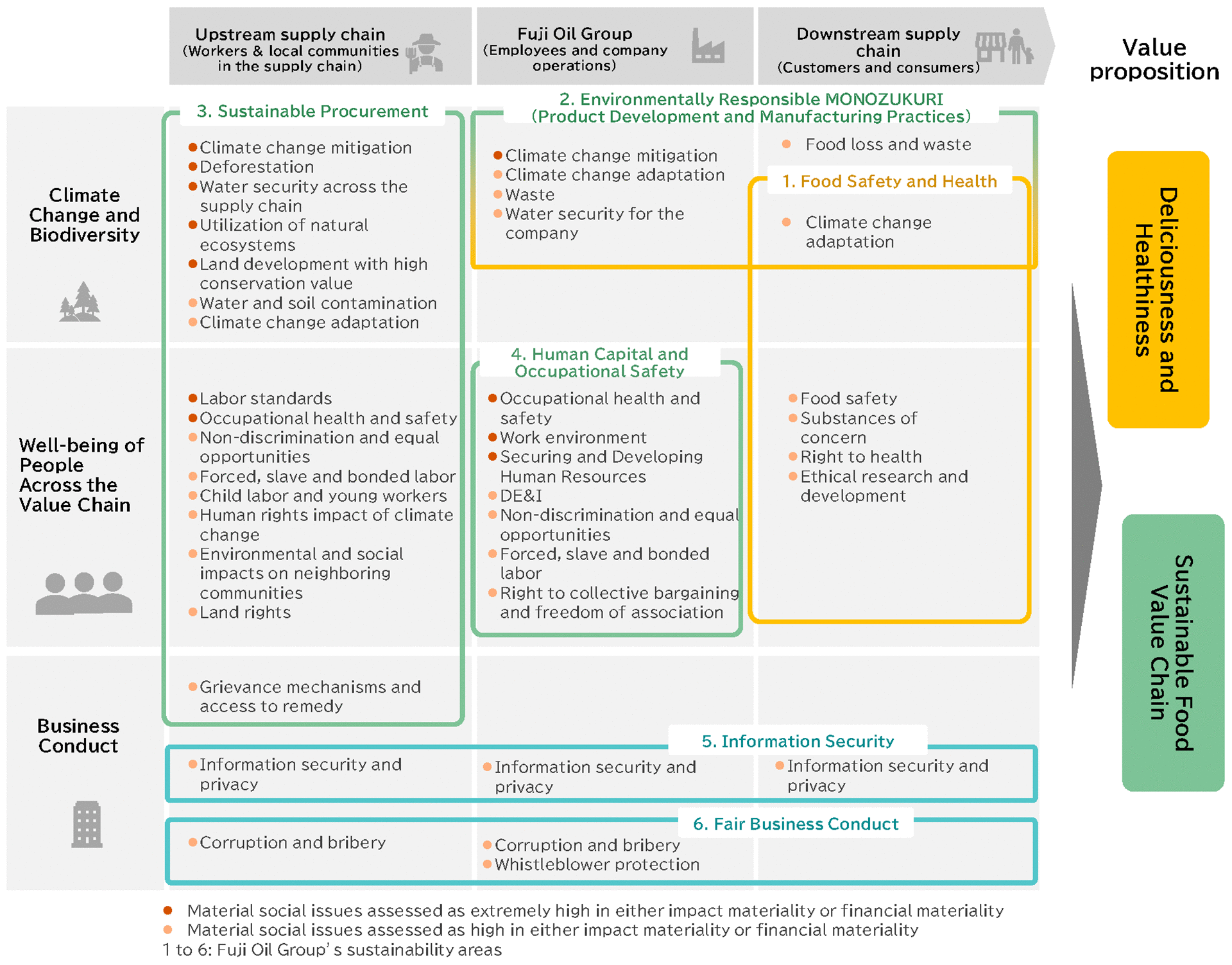
Image links to a PDF file(66KB)
Table: FY2026 material ESG issues (sustainability areas and priority actions) and chief officers in charge
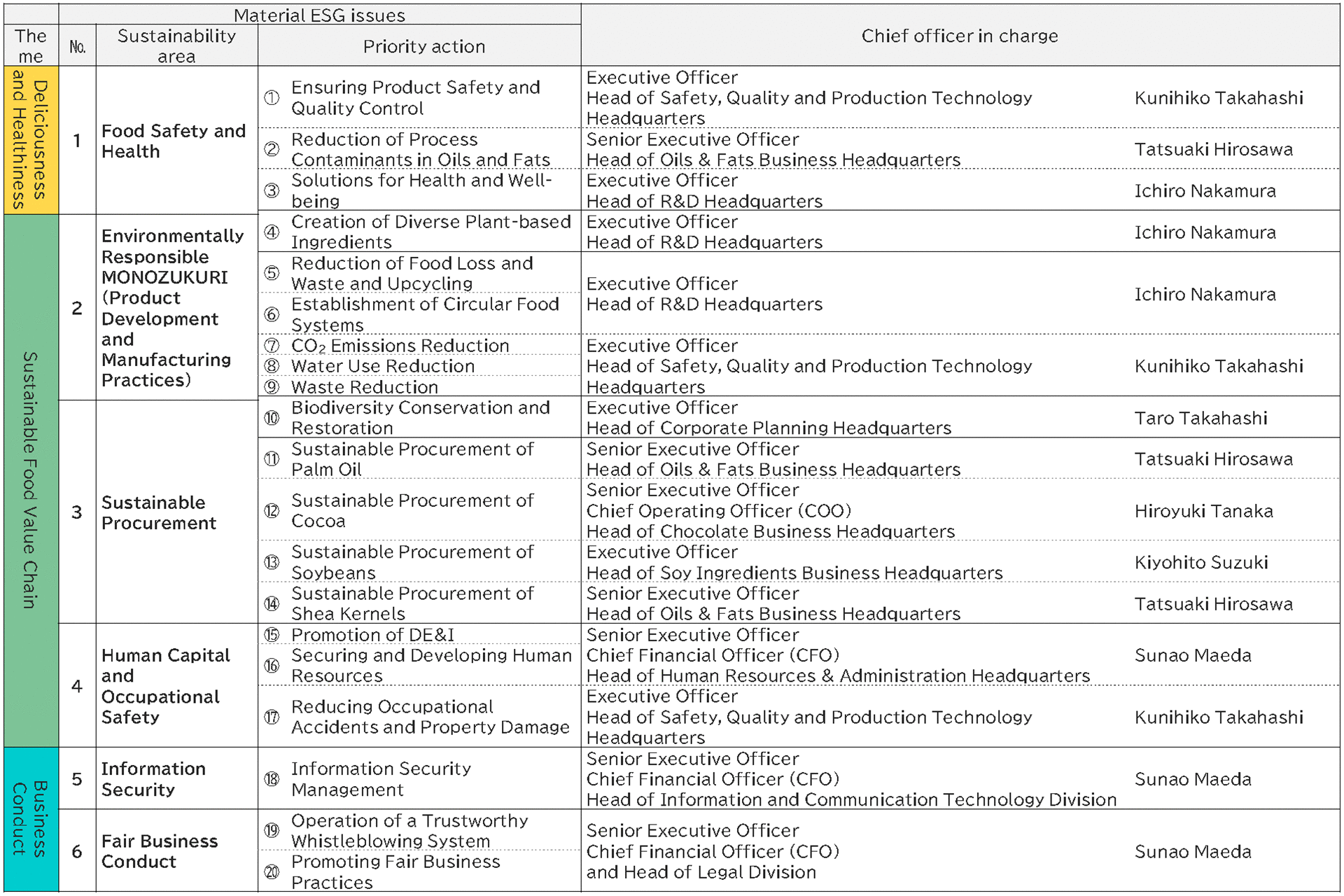
Image links to a PDF file(178KB)
-
See Metrics and Targets for details on our material ESG issues.
Material ESG issues assessment process for FY2026
In light of the changes in the business environment and social issues, our Group identifies new challenges through stakeholder engagement and conducts an annual review of its material ESG issues. This allows us to revise our material ESG issues (sustainability areas and priority actions) for the following fiscal year to make continuous improvements and enhance their effectiveness. For these material ESG issues, managing officers are appointed under the supervision of the chief officer in charge, and specific targets and measures are set for undertaking business-linked initiatives.
In FY2024, we enhanced our identification and selection process to align with the European Sustainability Reporting Standards (ESRS) approach, conducting a materiality assessment along two axes: (1) impact materiality (assessment of environmental and social impacts) and (2) financial materiality (assessment of financial impacts on the Group), using a double materiality approach. This allows us to assess material ESG issues in an integrated approach that takes into account the company’s impacts on the environment and society as well as the issues’ impacts on corporate value.
In FY2025, we verified the validity of scenarios used in the previous year and investigated any new social issues that may need consideration. Consequently, we maintained our current materiality framework as well as verified its validity before conducting our assessment of material ESG issues for FY2026. Through this process, we are able to manage our material ESG issues in a consistent manner while flexibly responding to changes in the external environment.
See the chart below for details on our assessment process.
Figure: Material ESG issues assessment process (conducted in FY2024)

Image links to a PDF file(204KB)
- *1 ESRS: European Sustainability Reporting Standards
- *2 Environmental Management
https://www.fujioil.co.jp/en/sustainability/environmental_management/ - *3 Human Rights Management
https://www.fujioil.co.jp/en/sustainability/human_rights/#impact_assessment - *4 Experts in the process of selecting material ESG issues (sustainability management in general), experts on human rights and biodiversity, institutional investors, our Group officers, outside directors, business divisions, functional divisions, finance divisions, and research and development divisions
Risk ManagementGRI:3-3
The Fuji Oil Group integrates risks and opportunities tied to various sustainability issues across our value chain with our strategic and financial risks, and classifies and manages them collectively as Group significant risks. Rather than treating sustainability issues as separate risks, this approach positions them at the core of the risk management of our overall business operations, enabling a multidimensional and systematic response.
This approach is particularly critical for our agricultural supply chains, which form the foundation of the Group’s businesses. Environmental risks such as climate change, ecological shifts, and biodiversity loss are compounded by human rights risks involving workers and local communities across the supply chain, creating significant management challenges. We identify and assess these risks across the entire value chain from a multidimensional perspective, prioritizing our responses according to their materiality.
Specifically, we use environmental management and human rights management frameworks to take preventive measures against risks and mitigate their impacts. We also strengthen our sustainable procurement and collaborate with suppliers to reduce these risks and create business opportunities. Essentially, an integrated approach to risk management and sustainability management enables us to build sustainable business operations and enhance corporate value.
For details on the Group’s risk management system, please visit the “Business risks” page.
- Business risks
https://www.fujioil.co.jp/en/ir/policies_and_systems/risk/
Sustainability awarenessGRI:2-17, 2-24
To effectively drive sustainability management across the organization, we conduct regular awareness-raising activities for officers and employees, covering topics such as global social trends, regulatory changes, our Group’s approach to sustainability management and specific initiatives.
These activities help individuals understand how sustainability relates to their own work, and reflect this understanding in their daily decision-making and actions. Ultimately, we foster a shared awareness of sustainability as an integral part of our management strategy to enhance the effectiveness of our group-wide initiatives.
Table: FY2025 sustainability awareness training for officers and employees
| Participants | Type | Topic | Purpose |
|---|---|---|---|
| Members of the Board of Directors | Briefing | Investor feedback on the Integrated Report 2025 | Enact feedback from investors on the integrated report published that year in order to deepen discussions that serve to help management and raise corporate value through further stakeholder dialogue |
| Officers at Fuji Oil Co., Ltd. | In-person training, dialogue Language: Japanese |
Business and human rights | Deepen understanding of the fundamental concepts and social demands related to business and human rights, as well as develop an objective understanding of Fuji Oil’s human rights response evaluation |
| Officers and employees at Group companies in and outside Japan | Posts on the company communications website Languages: Japanese, English, Chinese, Portuguese |
Sustainability information from within and outside the Group | Deepen understanding of sustainability management and stay informed of sustainability actions at other Group companies |
| Officers and employees at Fuji Oil Co., Ltd. | Training (in-person, online) Language: Japanese |
Creating sustainability together at Fuji Oil Co., Ltd. | Mandatory training conducted across all divisions to deepen understanding of sustainability concepts and sustainability management, and to raise awareness and facilitate information sharing in the field of sustainability in line with each division’s work |
| New employees | In-person study sessions Language: Japanese |
Sustainability management at Fuji Oil Group | Gain an understanding of the sustainability-related issues and initiatives in Fuji Oil Group’s businesses |
| Employees at Group companies in and outside Japan | Company communications website (Messages from our top management) Languages: Japanese, English, Chinese, Portuguese |
Business and human rights, compliance, and other issues | Instill an understanding of business and human rights, and compliance |
| Sustainability management awareness (Basics) e-learning Languages: Japanese, English, Chinese, Portuguese |
Sustainability management at Fuji Oil Group | Understand the basic points of the Group’s sustainability management in a systematic manner, and deepen understanding of sustainability-related issues and initiatives in the Group’s businesses |
Metrics and TargetsGRI:3-2,3-3
Material ESG issues for FY2026
For our material ESG issues and our vision for FY2026, and the goals and results for FY2025 are listed below.
Please refer to the relevant webpages for details on our basic approach and the status of initiatives concerning each issue.
| Theme | Material ESG issues | Our vision | FY2025 Goals | FY2025 Results | |||
|---|---|---|---|---|---|---|---|
| Sustainability area | Priority action/Chief officer in charge | ||||||
| Deliciousness and Healthiness |
As a food manufacturer, placing top priority on ensuring safe and quality food products is a prerequisite in our business. Amid growing concern about health issues, we help ensure that health and well-being remain balanced with the enjoyment of food. We do this by expanding the options for foods that help promote health and well-being and prevent cognitive decline in older people, and by minimizing the use of substances that do not comply with quality requirements. |
Ensuring Product Safety and Quality Control [Chief officer in charge] Head of Safety, Quality and Production Technology Headquarters / Executive Officer |
Ensure that the Fuji Oil Group is never a cause for complaints for any of the products it manufactures | No serious quality-related complaints*1 received | No serious quality-related complaints received | ||
| Strengthen communication with quality managers at Group companies and promote a food safety culture and the sharing of quality-related information | Information sharing on each company’s quality initiatives on key themes, findings from internal audits conducted by Fuji Oil Co., Ltd. | ||||||
|
Reduction of Process Contaminants*2 in Oils and Fats [Chief officer in charge] Head of Oils & Fats Business Headquarters / Senior Executive Officer |
Reduce process contaminant levels in line with market expectations | All Group companies work together to reduce process contaminants, incorporating new knowledge gained through research and development. | No customer complaint or product recall resulting from process contaminants | ||||
|
Solutions for Health and Well-being [Chief officer in charge] Head of R&D Headquarters / Executive Officer |
Clearly communicate the health value of our products that help build a society where people are mentally and physically healthy and lead purposeful lives. Expand the range of health values offered by our products | Publish evidence and obtain functional claims to support sales promotion by promoting the superior taste and health benefits of PRORARE®*3 |
|
||||
| Sustainable Food Value Chain |
Environmentally Responsible MONOZUKURI Amid concerns about shortages of protein sources, increasing environmental impact, and uneven food distribution due to population growth, we are working to develop plant-based proteins with low environmental impact, reduce food loss and waste and promote upcycling, and build a circular food system. In order to ensure the sustainability of our business, which relies on agricultural products for most of its raw materials, we must urgently address environmental issues, including climate change. To this end, we are working to reduce CO2 emissions, water consumption and waste, and to conserve biodiversity within our business operations and throughout our supply chain. |
Creation of Diverse Plant-based Ingredients [Chief officer in charge] Head of R&D Headquarters / Executive Officer |
Make plant-based foods widely and readily available. Increase dietary choices to help address food supply problems, and broaden new business fields | Develop new plant-based ingredients that cater to diversifying values | In plant-based ingredients developed through fermentation, oil and fats, and protein processing technologies, progress has exceeded the initial targets set for development and market launch | ||
|
Reduction of Food Loss and Waste and Upcycling [Chief officer in charge] Head of R&D Headquarters / Executive Officer |
Contribute to reducing food loss and waste across the value chain through technology innovation and reuse/upcycling of byproducts | [Reduction of Food Loss and Waste] Develop technologies and products to maintain food quality longer and extend best-before dates |
Developed cream products that blend with fresh cream to improve shelf life and handling. Currently gaining adoption mainly in the food service industry | ||||
| [Upcycling] Seek new functions and value through proactive and effective use of waste |
Progress made in developing new applications for soybean fiber and soy polysaccharides Ingredients with diverse functions are gaining recognition and seeing wider adoption | ||||||
|
Establishment of Circular Food Systems [Chief officer in charge] Head of R&D Headquarters / Executive Officer |
Develop soybean utilization technologies that contribute to a low-impact, sustainable circular economy that is resilient to the effects of climate change. | Verify cultivation in a medium-scale plant factory under CO2 fertilization conditions | Several cultivation trials conducted, with target yield achieved | ||||
|
[Chief officer in charge] Head of Safety, Quality and Production Technology Headquarters / Executive Officer |
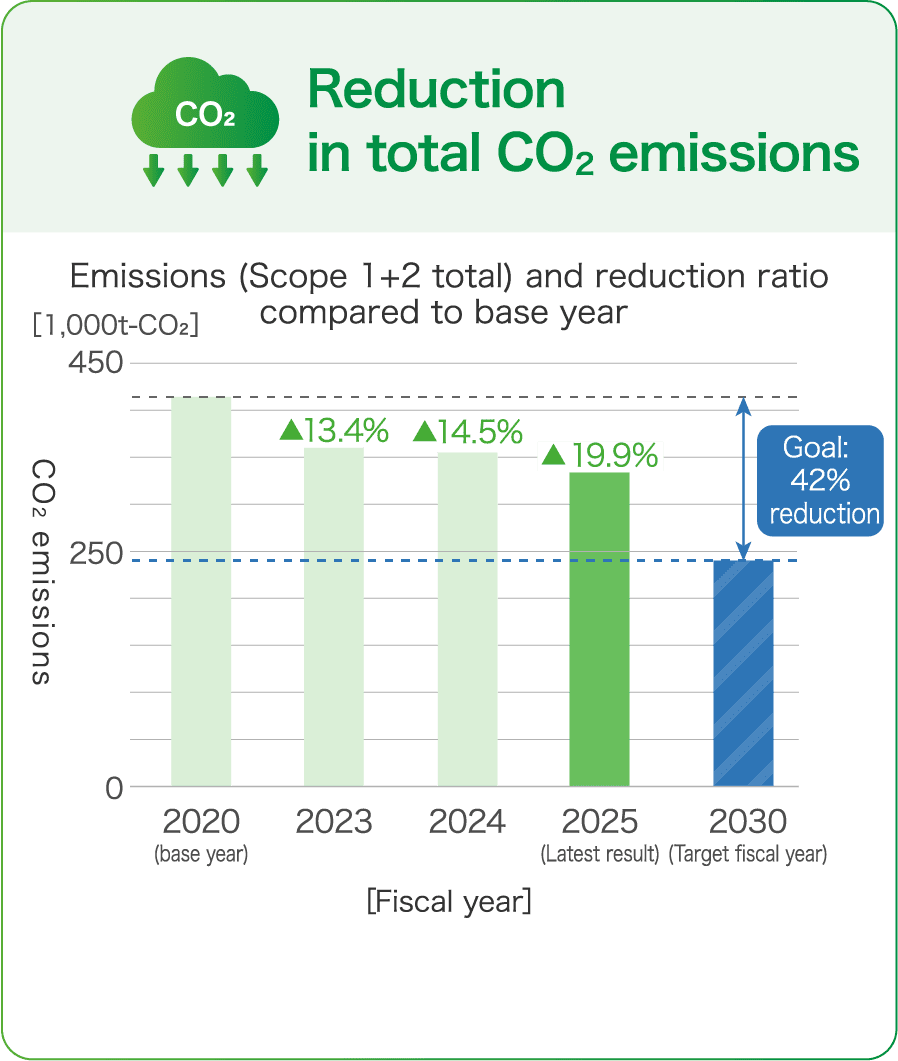
<Environmental Vision 2030/2050> FY2050 target: Net zero for total scope 1*4, 2*5 and 3*6 GHG emissions FY2030 target: Total scopes 1 & 2 GHG emissions: 42% reduction Total scope 3 (Category 1*7) GHG emissions: 25% reduction Total FLAG-related*8 GHG emissions: 30.3% reduction (base year: FY2020) |
[ FY2030 target ] Total scopes 1 & 2 GHG emissions: 42% reduction (All Group companies*9) |
- | 19.9% reduction*10 | |||
| [ FY2030 target ] Total scope 3 (Category 1) GHG emissions: 25% reduction (All Group companies*9) |
- | 11.7% reduction | |||||
| [ FY2030 target ] Total FLAG-related GHG emissions: 30.3% reduction (All Group companies*9) |
- | 14.2% reduction | |||||
| Scopes 1 & 2 emissions reduction | Continue energy conservation and introduction of renewable energy |
|
|||||
| Investigate energy management initiatives at Group companies in Japan | Assessed status of initiatives at each company and identified issues. Implemented measures to address issues | ||||||
| Further introduce the internal carbon pricing system at Group companies outside Japan | Started a trial implementation of internal carbon pricing at seven Group companies outside Japan | ||||||
| Scope 3 (Category 1) | Continue conducting supplier engagement | Engaged with 30 supplier companies in and outside Japan through online meetings and surveys | |||||
| FLAG | Collect information on reduction methods | Collected and compiled information on emissions reduction measures through external consultations | |||||
|
[Chief officer in charge] Head of Safety, Quality and Production Technology Headquarters / Executive Officer |
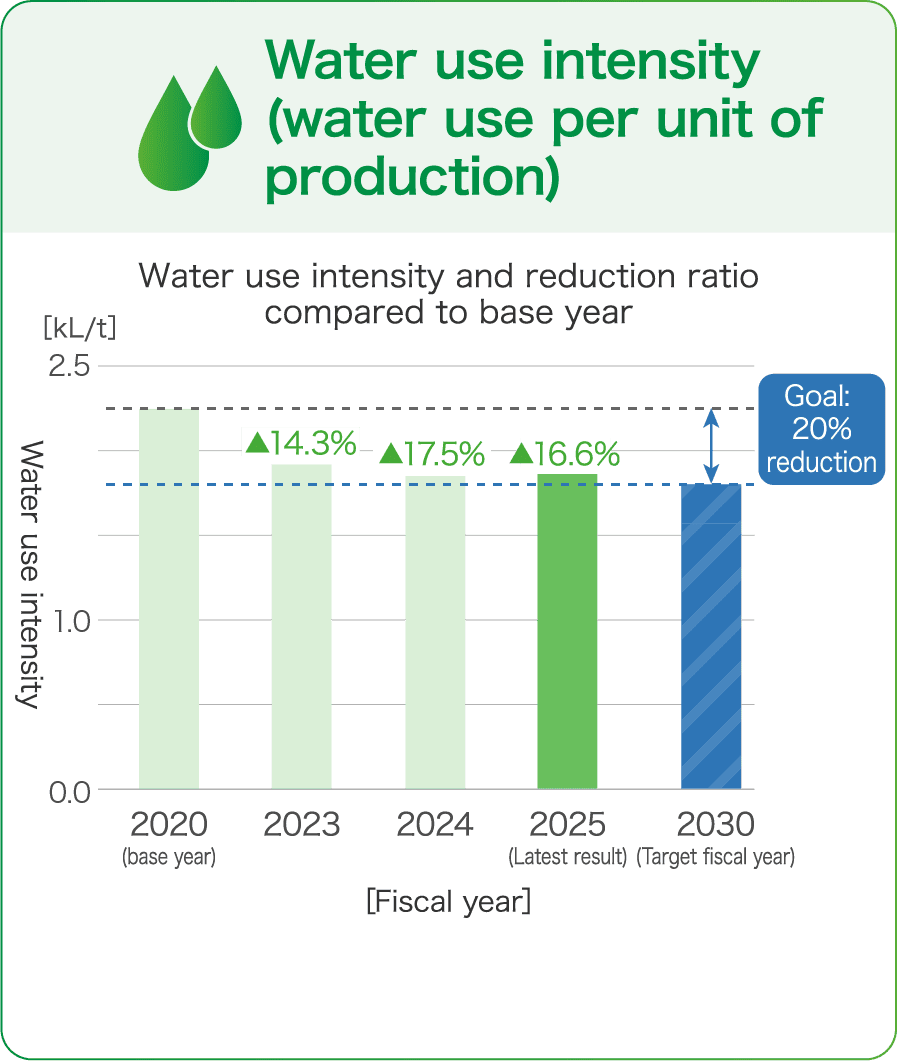
<Environmental Vision 2030/2050> FY2030 target: 20% reduction in water use volume per production volume*11 (base year: FY2020) |
[ FY2030 target ] 20% reduction in water intensity (All Group companies*9) |
16.6% reduction | ||||
| Broad deployment of successful examples of reduction efforts |
|
||||||
| Work to continuously reduce usage intensity by implementing the Plan-Do-Check-Act (PDCA) cycle through the implementation of environmental audits. | Used environmental audits to review environmental management practices and legal compliance, and shared information on current management standards and improvement needs. As the first step toward helping develop and implement improvement plans, the Group began by providing support for the “Plan” stage of the PDCA cycle. | ||||||
|
[Chief officer in charge] Head of Safety, Quality and Production Technology Headquarters / Executive Officer |
<Environmental Vision 2030/2050> FY2030 target: 10% reduction in waste volume per production volume*12 (base year: FY2016) FY2030 target for Group companies in Japan: Maintain a recycling rate of 99.8% or higher |
[ FY2030 target ] 10% reduction in waste intensity (All Group companies*9) |
23.4% reduction | ||||
| Maintain a recycling rate of at least 99.8% (All Group companies in Japan) | 99.83% | ||||||
| Broadly deploy successful examples of waste reduction efforts |
|
||||||
| Work to continuously reduce waste intensity by implementing the PDCA cycle through environmental audits and other measures | Used environmental audits to review environmental management practices and legal compliance, and shared information on current management standards and improvement needs. As the first step toward helping develop and implement improvement plans, the Group began by providing support for the “Plan” stage of the PDCA cycle. | ||||||
|
There are pressing issues that need to be addressed in the regions that produce the key and strategic raw materials used in our businesses. These are deforestation and destruction of natural ecosystems due to plantation developments, forced labor, and child labor. We conduct our business activities based on our Supplier Code of Conduct and responsible sourcing policies as part of securing sustainable procurement for the future. Going forward, we will continue to work on reducing our environmental impact and addressing human rights issues in production regions. |
Biodiversity Conservation and Restoration [Chief officer in charge] Head of Corporate Planning Headquarters / Executive Officer |
Build a nature-positive value chain | Consider additional biodiversity disclosure candidates based on TNFD core disclosure metrics | Calculated the amount of GHG fixed by using biochar as part of regenerative agriculture at palm oil smallholder farms in Sabah, Malaysia. Published in the Sustainability Report 2026 | |||
|
Sustainable Procurement of Palm Oil [Chief officer in charge] Head of Oils & Fats Business Headquarters / Senior Executive Officer |
<Medium- to long-term goal> <Sustainable procurement commitment> |
Traceability to mill (TTM): 100% | TTM:99% | ||||
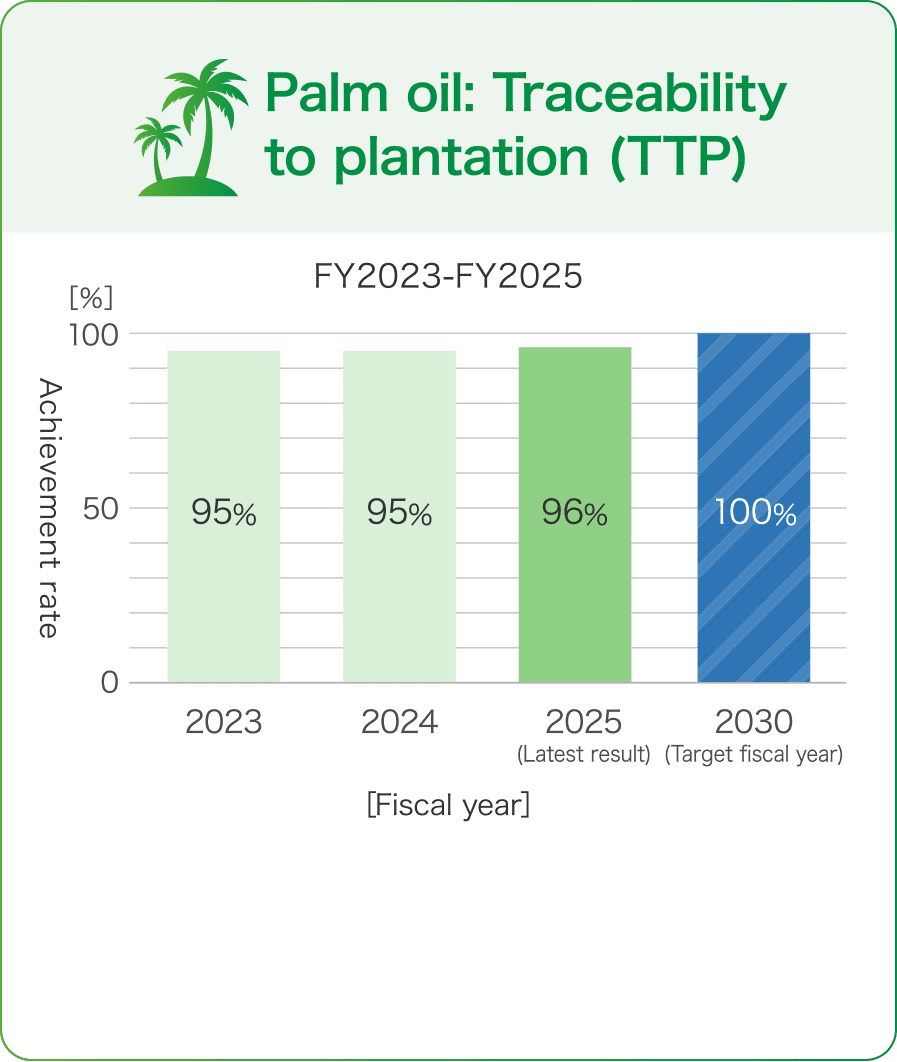
| Traceability to plantation (TTP): 85% | TTP:96% | ||||||
| Continue constant monitoring using satellite images to identify, observe, verify and eliminate deforestation in the palm oil supply chain | Monitoring implemented | ||||||
| Deforestation and Conversion Free (DCF) | 94.5%*13 | ||||||
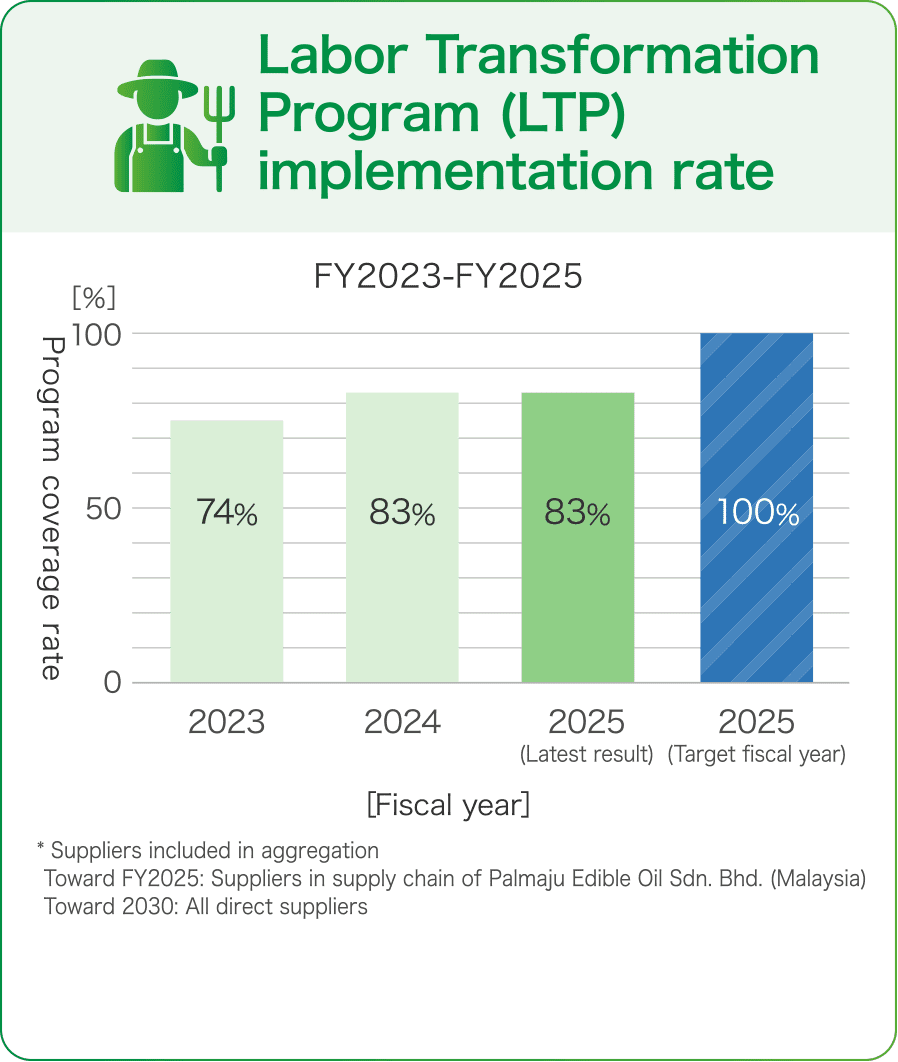
| Supply Chain Transformation Program at suppliers of Palmaju Edible Oil Sdn. Bhd. (Malaysia): 90% | 83% | ||||||
|
Sustainable Procurement of Cocoa [Chief officer in charge] Chief Operating Officer (COO) and Head of Chocolate Business Headquarters / Senior Executive Officer |
<Medium- to long-term goal> <Sustainable procurement commitment> |
Plant 103,000 trees to progress toward the Group goal of one million trees
|
Planted 54,308 trees (Planted 54,308 trees in partnership with AGRO-MAP. 0 saplings distributed through CFI) |
||||
| Maintain GPS mapping of 90% of farms in direct supply chain and improve traceability system | Completed mapping for 99.3% of farmers in the direct supply chain | ||||||
| Continue GAP*14 training to farms across our direct supply chain | Conducted GAP training for 15,340 farmers | ||||||
| Assess deforestation related to the supply chain using data provided by Satelligence*15 and conduct deforestation risk assessment for over 19,000 hectares of land | Conducted deforestation risk assessment for 46,489 hectares of land | ||||||
| Continue introducing the Child Labor Monitoring and Remediation System (CLMRS) in farmer communities across our direct supply chain*16 | 100% of farmer groups across our Group’s direct supply chain are covered by CLMRS | ||||||
| Provide support for women’s empowerment in 78 communities across our direct supply chain (Côte d’Ivoire, Ghana) | Women’s empowerment initiatives in 88 communities (Côte d'Ivoire only) | ||||||
|
Sustainable Procurement of Soybeans [Chief officer in charge] Head of Soy Ingredients Business Headquarters / Executive Officer |
<Medium- to long-term goal> <Sustainable procurement commitment> |
Traceability achieved to primary collection points, or 100% procurement of RTRS-certified products or products certified to equivalent standards | 100% traceability achieved to primary collection points | ||||
| Discuss actions to achieve Scope 3 reductions by implementing regenerative agriculture programs | Reviewed the program details and conducted on-site check of farmers implementing the programs | ||||||
|
Sustainable Procurement of Shea Kernels [Chief officer in charge] Head of Oils & Fats Business Headquarters / Senior Executive Officer |
<Medium- to long-term goal> <Sustainable procurement commitment> |
6,000 trees planted/year | 12,325 trees planted/year (total since 2021: 37,215 trees) |
||||
| Traceability to the regional level, including procurement from Tebma-Kandu cooperatives*18: 70% | 97% | ||||||
| Procurement of shea kernels from Tebma-Kandu program: 30% | 30% | ||||||
| Percentage of shea kernels crushed and fractionated (separated) in West Africa: 100% | 100% | ||||||
| Non-fossil fuel energy used by Fuji Oil Ghana Ltd. (for steam generation): 100% | 98% | ||||||
| Percentage of Group-donated storage buildings being used to generate alternative income for Tebma-Kandu cooperatives: 20% | 90% | ||||||
|
Human Capital and Occupational Safety Employee safety is the foundation of our business activities. We create a safe and secure workplace by ensuring the health and safety of our employees, based on the idea that safety comes first. In addition, creating a workplace that accepts diverse values and encourages individuality as well as acquiring and developing human resources is crucial for innovation and for responding to diversifying customer needs and values and enhancing our competence. To this end, we respect the diversity of our employees, foster an organizational culture that promotes employee autonomy and engagement, and practice our Fuji Oil Group Management Philosophy to “Work for people” so that all our employees can make the most of their abilities. |
[Chief officer in charge] Chief Financial Officer (CFO) and Head of Human Resources & Administration Headquarters / Senior Executive Officer |
Equity: Remove barriers experienced by people from disadvantaged communities, provide equitable opportunities and conduct fair evaluations Inclusion: Build a corporate culture that fosters a feeling of belonging among all employees Diversity: Harness diversity for our business model and value creation |
Ensure diversity at decision-making levels | In line with our new organizational structure, diversity metrics and scope are currently under review, with redefinition planned for FY2026 | |||
| Formulate and raise awareness of DE&I policies |
|
||||||
| Establish a Cross-Border Engagement Team to implement measures to improve employee engagement |
|
||||||
| Enhance Hataraki-Gai*25 (work engagement) KPI: Engagement survey overall score |
75% | ||||||
| Encourage diverse ways of working | Partially revised re-employment contract program | ||||||
| Support long-term, meaningful employment of people with disabilities |
|
||||||
|
Securing and Developing Human Resources [Chief officer in charge] Chief Financial Officer (CFO) and Head of Human Resources & Administration Headquarters / Senior Executive Officer |
Further increase number of specialists in every field, with many of our talents contributing to increasing corporate value in the face of changes in and outside Japan Have successor candidates always ready to take over for key positions (executive officers, department managers, section managers) |
Stronger governance by the Nomination and Compensation Advisory Committee |
|
||||
| Develop the next generation of management talent |
|
||||||
| Assign Human Resource Business Partners (HRBPs) to each business headquarters |
|
||||||
| Optimal placement and succession planning for positions key to business strategy |
|
||||||
| Develop global talent within the Group to support global expansion |
|
||||||
|
|||||||
|
|||||||
|
Reducing Occupational Accidents and Property Damage [Chief officer in charge] Head of Safety, Quality and Production Technology Headquarters / Executive Officer |
Place top priority on safety and respect for employees. Keep all Group companies accident-free by creating safe and comfortable workplaces | Zero serious accidents*26 | One serious accident: one fatal accident occurred at Fuji Oil Ghana Ltd. | ||||
| Zero serious property damage accidents*27 | Zero serious property damage accidents occurred | ||||||
| Business Conduct |
In a highly uncertain business environment, conducting risk-resilient business management is vital. We aim to enhance corporate value by strengthening Group governance through initiatives to minimize the likelihood of risks materializing and their impact if they do, such as by strengthening the Business Continuity Plan (BCP) and information security, and by conducting fair business conduct. |
Information Security Management [Chief officer in charge] Chief Financial Officer (CFO) and Head of Information and Communication Technology Division / Senior Executive Officer |
Sustainably develop the Group through responsive systems and enhanced measures to counter IT security risks that have significant impacts on business management | Continue conducting measure evaluations by CSIRT, which include internal security audits (FY2025 plan: IT evaluation for six companies) | Completed IT evaluation at nine companies | ||
| Prepare new audit procedure documents for IT and OT audits, and define assessment criteria for audit items | Completed preparation of new audit procedures and definition of assessment criteria for audit items, for use starting from FY2026 audits | ||||||
| Conduct education through global e-learning programs to raise employees’ security awareness (Target: 100% completion rate) | 98.7% completion rate | ||||||
|
In a highly uncertain business environment, building resilience and conducting risk-proof business management is vital. We aim to enhance corporate value by strengthening Group governance through initiatives to minimize the likelihood of risk occurrence and impact in case of occurrence, such as by strengthening the Business Continuity Plan (BCP) and information security, and by conducting fair business conduct. |
Operation of a Trustworthy Whistleblowing System / Promoting Fair Business Practices [Chief officer in charge] Chief Financial Officer (CFO) and Head of Legal Division / Senior Executive Officer |
Earn the trust of all stakeholders by conducting business fairly, transparently, and with integrity | No serious compliance violations | Zero cases of serious compliance violations | |||
| Foster trust in the whistleblowing system | The chief officer in charge of compliance sent a message to the entire Group, which included the use of the whistleblowing system | ||||||
| Create a psychologically safe environment for whistleblowing | Lawyer in charge of the whistleblowing hotline conducted training and widely shared information on the whistleblowing system | ||||||
| Conduct a compliance program targeting the entire Group | Held global e-learning and group training programs as described above | ||||||
| Raise employee awareness of compliance | Received a 90.9% positive response rate to the question, “Does your workplace have a culture in which compliance is given priority when business and compliance are in conflict?” (an increase of 0.6 percentage points from the previous year) | ||||||


- *1 Serious quality-related complaints: Incidents concerning food products that are harmful to health or violate the law, and require a recall.
- *2 Process contaminant: Trace elements that are introduced or formed during the production process.
- *3 PRORARE®: DHA oil treated with a proprietary process to suppress oxidation.
- *4 Scope 1: Direct emissions of greenhouse gases from our own operations (Covers direct GHG emissions from fuel combustion and manufacturing processes at our Group’s manufacturing bases and business sites in and outside Japan).
- *5 Scope 2: Indirect emissions of greenhouse gases from the use of electricity, heat and steam supplied by third parties (Covers GHG emissions associated with the use of purchased energy, including electricity and steam, at our Group’s manufacturing bases and business sites in and outside Japan).
- *6 Scope 3: Emissions from the activities of non-Group companies in our value chain
- *7 Scope 3 (Category 1): Covers only non-FLAG GHG emissions associated with purchased raw materials, supplies, and other goods and services, excluding FLAG-related emissions.
- *8 FLAG-related: GHG emissions from land conversion, agriculture and land management, and carbon removals. FLAG: Forest, Land and Agriculture
- *9 All Group companies: See list of Group companies (excluding Provence Huiles S.A.S. (France)).
https://www.fujioil.co.jp/pdf/en/sustainability/download/esg2026.pdf#page=14(849KB) - *10 Although the Fuji Oil Group’s reduction targets are set with GHG emissions, CO₂ accounts for 94% of the total GHG emissions (FY2025 results). Accordingly, actual CO₂ emissions (the primary source of GHG emissions) are reported.
- *11 Water use intensity: Water use per unit of production
- *12 Waste intensity: Waste volume per unit of production
- *13 Results for Jan–Dec 2024, verified in FY2025.
- *14 GAP: Good Agricultural Practices
- *15 Satelligence: A company providing analysis services using satellite data to detect and visualize deforestation and land-use change.
https://satelligence.com/news/satelligence-and-blommer-partner-to-fight-deforestation-in-cocoa-areas - *16 In West Africa
- *17 RTRS: Round Table on Responsible Soy Association
- *18 Tebma-Kandu cooperatives: Cooperatives registered in the Tebma-Kandu program and partners that are operating in accordance with Tebma-Kandu principles.
- *19 Procurement of shea kernels: This includes procurement volumes from new partners who have aligned with the aims of Tebma-Kandu, in addition to the cooperatives that have been active from the outset based on the concept of the Tebma-Kandu program.
- *20 Non-fossil fuel energy: Shea olein created as a byproduct when fractionating shea butter is used as biomass fuel.
- *21 Percentage of storage buildings for shea kernel storage donated by Fuji Oil Ghana Ltd. that are generating income through the use of vacant space or periods outside the shea season to store harvests other than shea.
- *22 DE&I: Diversity, equity and inclusion
- *23 Promotion of DE&I: A term encapsulating the concepts and practices of providing equitable opportunities and evaluations and developing and leveraging diverse talent through inclusive management.
- *24 DE&I Vision
https://www.fujioil.co.jp/en/sustainability/diversity/ - *25 Hataraki-Gai: A work-related and positive state of mind, characterized by vigor, dedication, and absorption. Used as a Group-wide internal term in our human resource strategy.
- *26 Serious accident: An accident resulting in death, permanent disability to limbs or other body parts, or long-term hospitalization (60 days or more).
- *27 Serious property damage accident: Explosions, fires, or physical accidents resulting in an order from a public authority to shut down the entire site.
- OverviewStrategy Management
- Governance
- StrategyMaterial ESG issues
- Risk Management
- Metrics and Targets