
Human Capital and Occupational Safety
Sustainability
Management
Material ESG Issues
Human Capital and Occupational Safety
Sustainability Areas
Priority Actions
PolicyGRI: 2-23
Based on our belief that people are the key to sustainable business and value creation, we view human capital and occupational safety as an important management foundation of the Fuji Oil Group.
We have formulated a new human resources strategy, aiming to be a Group where people with diverse values and expertise can work with a sense of Hataraki-Gai (work engagement).*1 Guided by our DE&I Vision*2 and Well-being Vision, we are working on themes including securing and developing human resources, promoting DE&I, transforming the work environment, and health and productivity management.
Based on the idea that safety is always the top priority, “safety, quality and the environment” are stated in the Fuji Oil Group Management Philosophy as values that all employees should uphold in their actions.
We recognize safety as an absolute prerequisite for employees to work feeling safe and healthy in their workplace and fulfil their potential. By advancing human resources strategy and occupational safety as a whole Group, we value the dignity and potential of every employee, aiming to always be a company that works for people.
Our policies related to human capital and occupational safety are listed below.
Policies on promotion of DE&I and securing and developing human resources
Based on the Fuji Oil Group Management Philosophy*3 and the Fuji Oil Group Human Rights Guidelines*4 established in March 2023, we formulated a new human resources strategy in FY2025. This strategy includes our DE&I Vision and Well-being Vision, setting out our policies for human resources development and workplace environment development.
Regarding promotion of DE&I, we previously formulated the Basic Diversity Policy in 2015 and Fuji Oil Group Diversity Vision in May 2020. With the revised human resources strategy, these have now been integrated into the DE&I Vision.
Policies on maintaining and promoting employee health (health and productivity management)
We published the Fuji Oil Co., Ltd. Health and Productivity Management Declaration*5 in January 2017 to show our commitment to proactively engaging in health and productivity management.
Policies on reducing occupational accidents and property damage
Based on the Fuji Oil Group Basic Policy of Safety, Quality and Environment,*6 we are working to reduce occupational accidents and property damage by viewing safety, quality and the environment together.
-
*1 Hataraki-Gai: A work-related and positive state of mind, characterized by vigor, dedication, and absorption. Used as a Group-wide internal term in our human resource strategy.
-
*2 DE&I Vision
https://www.fujioil.co.jp/en/sustainability/diversity/#issue
-
*3 Fuji Oil Group Management Philosophy
-
*4 Fuji Oil Group Human Rights Guidelines
https://www.fujioil.co.jp/en/sustainability/policy/human_rights_guideline/
-
*5 Fuji Oil Co., Ltd. Health and Productivity Management Declaration (in Japanese)
-
*6 Fuji Oil Group Basic Policy of Safety, Quality and Environment
https://www.fujioil.co.jp/en/sustainability/policy/basic_policy/
Fuji Oil Group Human Resources Strategy (Established 2025)
Under the business holding company structure in place since April 2025, our Group companies work together to provide solutions to the challenges facing people and the planet through plant-based ingredients, aiming to create innovative value and sustainable growth. Knowing that our people are the key to making this happen, we have reconsidered the actions we should take and formulated a new, unified human resources strategy to guide the entire Group.
One of our Group’s strengths is our diverse talent: people who love food, enjoy collaboration and challenge, and work for people in many different countries. We will increase Hataraki-Gai of our employees, and drive innovation through co-creation. By creating a cycle of sustainable growth and smiles across the Group and among our employees, we will co-create a sustainable future for food.
Figure: Fuji Oil Group Human Resources Strategy
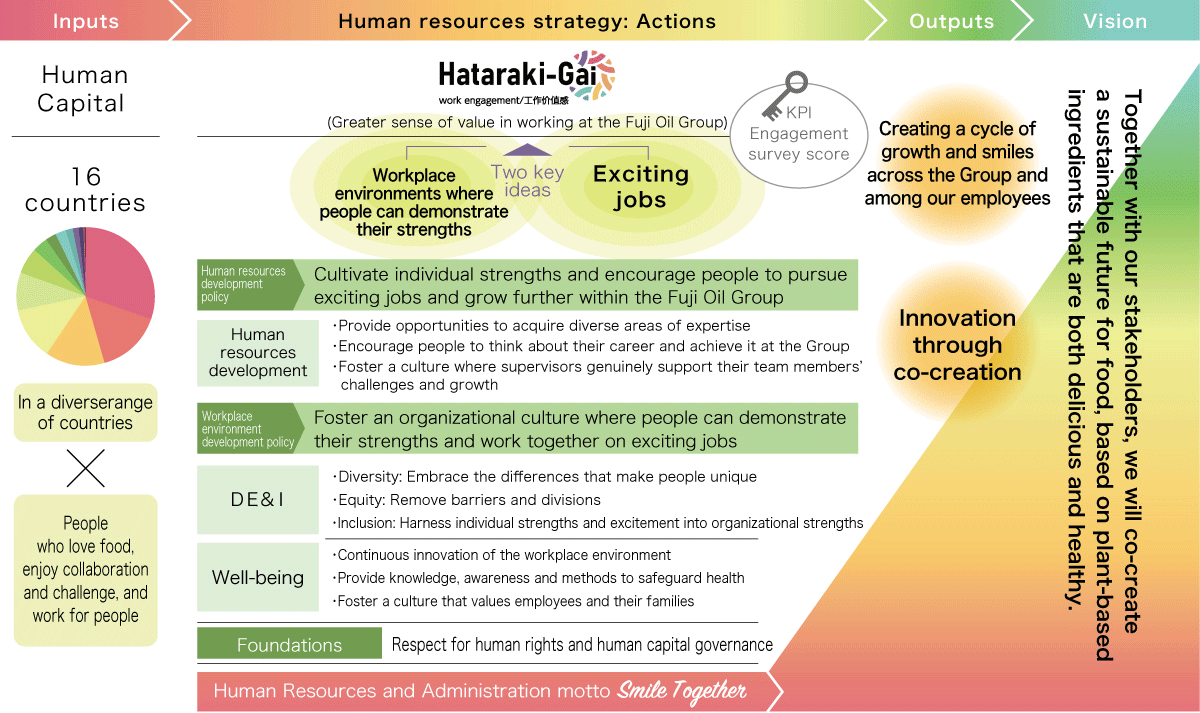
Image links to a PDF file(85KB)
GovernanceGRI: 2-12,2-13,2-14,3-3
The Fuji Oil Group has established the Sustainability Committee*1 as an advisory body to the Board of Directors that is chaired by the President and CEO. The committee assesses the impact that risks and opportunities related to human capital and other sustainability issues will have on our business and corporate value over the medium to long term. Based on the assessment results, the committee deliberates on and monitors each priority action to address material ESG issues from a multi-stakeholder perspective, and makes recommendations to the Board. We implement our initiatives under the oversight of chief officers in charge of each priority action, based on policy, strategy, metrics and targets.*2 The Sustainability Committee and Board of Directors continuously monitor the progress on these priority actions.
This governance structure ensures that initiatives related to human capital and occupational safety are integrated into our business strategy, leading to maximized value of human capital and sustainable improvement in corporate value.
Table: Chief officers in charge of each priority action
| Priority action | Chief officer in charge |
|---|---|
| Promotion of DE&I | Senior Executive Officer Chief Financial Officer (CFO) and Head of Human Resources & Administration Headquarters |
| Securing and Developing Human Resources | |
| Reducing Occupational Accidents and Property Damage | Executive Officer Head of Safety, Quality and Production Technology Headquarters |
-
*1 Fuji Oil Group’s sustainability management > Governance
https://www.fujioil.co.jp/en/sustainability/sustainability_management/?tab=1
-
*2 Fuji Oil Group’s sustainability management > Metrics and Targets
https://www.fujioil.co.jp/en/sustainability/sustainability_management/?tab=4
Nomination and Compensation Advisory Committee
Our Group has established the Nomination and Compensation Advisory Committee as a discretionary advisory body to the Board of Directors. At the request of the Board, the Committee monitors and deliberates on matters such as the composition of the Board including diversity, development and nomination of candidates for Directors and Executive Officers, and the executive remuneration system, reporting its findings to the Board. The Committee is made up of three to six Directors appointed by resolution of the Board. From the viewpoint of objectivity and transparency in decision-making, the majority of members are independent outside directors, and the Committee is chaired by an independent outside director.
StrategyGRI: 3-3
Strategy for creating corporate value through enhancing human capital and occupational safety
To better respond to diversifying customer needs, co-create with stakeholders, drive innovation, and strengthen our competitiveness, it is essential to create a workplace environment where diverse values are mutually respected and individuals can demonstrate their strengths, as well as securing and developing the human resources essential to our business strategy. Ensuring our employees’ safety is an absolute foundation for continuing business operations and constantly creating value. As such, ensuring occupational safety and maintaining the physical health and mental well-being of employees are crucial responsibilities for us as a manufacturer.
With this in mind, we have positioned the following three areas as interconnected strategic pillars: (1) Promotion of DE&I, (2) Securing and developing human resources, and (3) Occupational safety. We aim to develop human resources and workplace environments where everyone can work safely and with a sense of Hataraki-Gai.
- (1) Promotion of DE&I: Leveraging diversity as a strength leading to innovation and value creation, we are implementing efforts to improve employee engagement across the Group, while enhancing monitoring and the Plan-Do-Check-Act (PDCA) cycle for improvement.
- (2) Securing and developing human resources: We will increase linkage with our management strategy and business strategy to make sure we recruit the talent we need. We will also build training systems to enhance people’s expertise and mechanisms to develop the next generation of leaders who can perform on the global stage.
- (3) Occupational safety: We are working to maintain and improve workplace environments where people can work safely by preventing occupational accidents and property damage and making continuous improvements.
Through these efforts, we will maximize the value of our human capital, leading to the constant creation of corporate value.
Strategy Matrix
Fuji Oil Group’s Approach
| Reasons for importance | Initiatives to enhance business capital | |
|---|---|---|
|
Natural capital | - |
| Social and relationship capital |
|
|
| Direction of initiatives | Manufactured capital | - |
|
Intellectual capital | - |
| Human capital |
|
|
Strategy
| Priority action | Promotion of DE&I | Securing and Developing Human Resources | Reducing Occupational Accidents and Property Damage | |
|---|---|---|---|---|
| Risks |
|
|
|
|
| Opportunities |
|
|
||
| Financial impact of risks and opportunities | Short-term | Medium | High | Low |
| Medium-term | High | High | Low | |
| Long-term | Very high | High | Low | |
| Value chain | Upstream | - | - | - |
| Group | ● | ● | ● | |
| Downstream | - | - | - | |
| Vision and goals |
|
|
|
|
| Environmental and social impacts | Negative impacts to be reduced |
|
- |
|
| Positive impacts to be created |
|
|
- | |
| Connection to key policy of the medium-term management plan |
|
|
|
|
-
* Hataraki-Gai : A work-related and positive state of mind, characterized by vigor, dedication, and absorption. Used as a Group-wide internal term in our human resource strategy.
Risk management
Our Group systematically manages risks and opportunities related to the sustainability area of Human Capital and Occupational Safety in relation to Group significant risks within our Group-wide risk management framework. Specifically, risks and opportunities related to this area are linked to the following risk types of Group significant risks: Disasters and accidents, Environment and human rights, Procurement, and Labor and human resources. We monitor and evaluate them from the perspectives of business strategy, business continuity, and impact on the entire supply chain. In this way, we take a holistic view of risks and opportunities related to human capital and occupational safety, and integrate them with our business strategy, human resources strategy, and business continuity planning to implement effective risk management and strengthening our efforts.
-
Group significant risks > Risk type: Disasters and accidents/ Environment and human rights/ Procurement/ Labor and human resources
https://www.fujioil.co.jp/en/ir/policies_and_systems/risk/#significant_risks
Specific details of risk management implemented for each priority action are included in the following links.