
Sustainable Procurement of Palm Oil
Material Issue
Sustainable Procurement
Policy
In March 2016, we formulated the Fuji Oil Group’s Responsible Palm Oil Sourcing Policy. In this Policy, we stated our commitment to No Deforestation, No Peatland Development and No Exploitation (NDPE) in our palm oil supply chain. We are procuring palm oil produced in a responsible manner from suppliers who respect people and the global environment.
-
Responsible Palm Oil Sourcing Policy
https://www.fujioil.co.jp/en/sustainability/policy/palm_procurement/
Governance
The Fuji Oil Group has established the Sustainability Committee*1 as an advisory body to the Board of Directors that is chaired by the President and CEO. From a multi-stakeholder perspective, the committee deliberates on and monitors Sustainable Procurement of Palm Oil, a priority action to address material ESG issues,*2 and makes recommendations to the Board. The Group implements related initiatives under the oversight of Head of Oils and Fats Business Headquarters, the Senior Executive Officer.
-
*1 Governance, Strategy, Risk Management, Metrics and Targets > Governance
https://www.fujioil.co.jp/en/sustainability/sustainability_management/#governance
-
*2 Governance, Strategy, Risk Management, Metrics and Targets > Metrics and targets
https://www.fujioil.co.jp/en/sustainability/sustainability_management/#index
StrategyGRI: 2-6
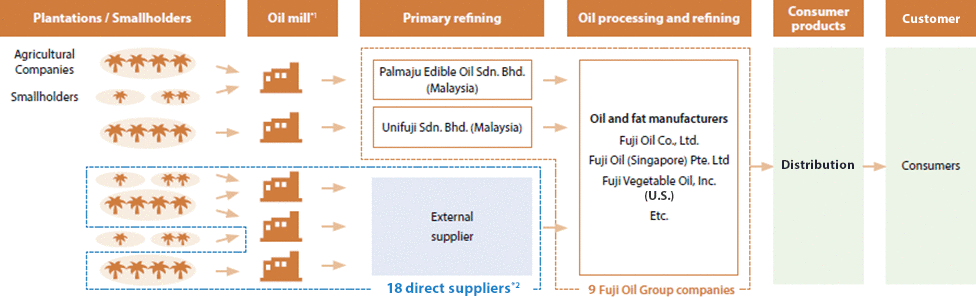
Palm oil is extracted from the fruit of the oil palm, which grows in tropical regions such as Southeast Asia. Our Group procures palm oil, mainly from Malaysia and Indonesia, as the key raw material for our businesses like the Vegetable Oils and Fats Business. Palm oil is easier to process and has a higher yield per unit area than other vegetable oils and fats. For this reason, palm oil is used in a wide range of applications, from foods to chemical products, and has the largest production volume among vegetable oil and fat materials in the world. On the other hand, there have been concerns over environmental and social impacts tied to plantation development, such as deforestation and human rights violations, including child labor and forced labor.
Under the Responsible Palm Oil Sourcing Policy, our Group has set medium- to long-term goals in order to work on improving various issues through efforts such as strengthening traceability, monitoring and responding to deforestation using satellite imagery, implementing working environment improvement programs to protect human rights, and establishing grievance mechanisms. These commitments stated in the policy apply not only to our operations, but also to our entire palm oil supply chain. By achieving our commitments, we fulfill our environmental and social responsibilities, thereby enhancing our corporate reputation and creating greater business opportunities.
-
*1 Our mill list (July to December 2024)
https://www.fujioil.co.jp/pdf/en/sustainability/supplychain_database/h2_2024_mill_list.pdf
- For the latest mill list, please refer to our supply chain database.
-
*2 As of September 2024
Risk management
The Fuji Oil Group systematically manages risks and opportunities related to Sustainable Procurement, an area of sustainability matters that address material ESG issues, in alignment with Group significant risks.
-
Group significant risks
Risk type: Environment and human rights/ Procurement -
Sustainable Procurement Management > Risk management
https://www.fujioil.co.jp/en/sustainability/procurement/#risk_management
Traceability
We need to foster better supply chain transparency in our journey toward achieving sustainable procurement. To this end, our Group is working on monitoring and assessing our traceability, which enables us to prevent, minimize, mitigate, and manage the environmental and social risks associated with palm oil production in our supply chain. The Oils and Fats Business Headquarters collects and verifies the traceability data of our palm oil supply chain once every six months to confirm that the raw materials we purchase are being produced responsibly.
As of December 2024, we achieved 100% traceability to mill (TTM) and 95% traceability to plantation (TTP) .
Satellite-based monitoring (Location/scope: Indonesia, Malaysia, Papua New Guinea)
Since FY2020, our Group has been working with the non-profit Earthqualizer to use satellite technology to identify, monitor, and verify the risk of deforestation in the Group’s palm oil supply chain. Satellite images of plantations and surrounding areas are extremely useful in identifying, mitigating, and preventing deforestation. Based on the reports we receive twice a month from Earthqualizer, we manage all allegations related to deforestation submitted to the Group through our grievance mechanism in order to begin our investigations.
When identifying whether an allegation made through our grievance mechanism is relevant to the Group’s supply chain, traceability data is essential. If an allegation is found to be relevant through the results of matching our traceability data with the satellite images, we further investigate the actual situation with the related direct supplier(s). We work closely with Earthqualizer to address cases of deforestation in the Group’s supply chain, including handling grievances, establishing solutions with suppliers, and communicating with NGOs and other stakeholders. We incorporate the investigation results and update the information in our grievance list at least once a quarter.*
Supply Chain Transformation Program(Location/scope: Malaysia)
In 2017, the Fuji Oil Group launched a Labor Transformation Program (LTP) at Palmaju Edible Oil Sdn. Bhd. (Malaysia), a Group subsidiary, in collaboration with the non-profit Earthworm Foundation. This program provides tailored support for addressing human rights-related issues to all of the company’s suppliers. LTP has been introduced to the company’s direct suppliers, and is now being expanded to all indirect suppliers. The scope of the program includes the following eight elements.
- Freedom of movement
- Contract management
- Ethical employment
- Grievance management (through grievance mechanism)
- Wages and working hours
- Freedom of association
- Health and safety
- Accommodation
Under this program, we provide the following support to our suppliers, to reduce human rights risks at their business and supply locations.
- Provide information and documents to support suppliers to ensure compliance
- Conduct practical training of dedicated staff and departments
- Raise suppliers’ awareness of industry requirements
- Help suppliers apply international standards to their labor management
- Help suppliers obtain certification and meet customer requirements
To maximize the impact and effectiveness of our engagement, these activities are typically done face-to-face with local factory and plantation managers individually. As of March 2025, 83% of Palmaju Edible Oil Sdn. Bhd. (Malaysia) suppliers are covered by the program.
The program helps the company’s suppliers build and develop better management systems, enabling them to improve labor management and address labor-related issues raised by stakeholders.
Because reorganization of the company’s supply chain is expected to affect progress with these efforts, we recognize the need to review the KPIs and plan to update them at the appropriate time in the future. The Group will continue working toward our goal of 100% LTP implementation across the supply chain to achieve zero exploitation ― an urgent issue from the perspective of stakeholders.
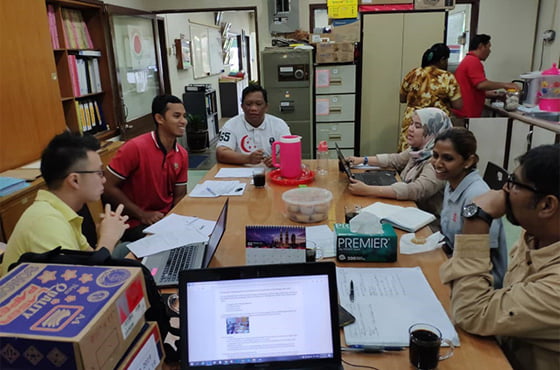
Interviewing workers through the program (September 2024)
Self-assessment tools(Location/scope: The Group's palm oil supply chain)
In cooperation with the non-profit Earthworm Foundation, the Group works on encouraging Palmaju Edible Oil Sdn. Bhd. (Malaysia) suppliers to conduct self-assessments. Using self-assessment tools, suppliers are able assess and monitor their situation and sustainability performance. These are critical tools in the supply chain due diligence process, making it possible for us to reach out to suppliers more extensively and efficiently.
The following shows our progress in FY2024.
Rate of self-assessment questionnaire and action plan submission in FY2024
Palmaju Edible Oil Sdn. Bhd. (Malaysia)
- Direct suppliers: 43%
- Indirect suppliers: 64%
- Plantations: From 24 plantations
The rate of submission has decreased compared to 2023. This is due to a transition to a new platform and delays in launching the system.
This initiative enables us to make recommendations and provide support to help suppliers improve their business operations in line with the Group’s policies. It also allows suppliers to share information about their own sustainability efforts and report on how well they are doing in meeting the requirements of the Group’s Responsible Palm Oil Sourcing Policy.
To further support our suppliers, we are currently developing an easier-to-use due diligence system that enables us to obtain more accurate information.
Moving forward, we will continue to strengthen our due diligence system by reporting progress on NDPE in our supply chain.
Engagement toward zero deforestation(Location/scope: The Group’s palm oil supply chain)
The Group proactively engages with our suppliers to identify the most effective approach to achieving zero deforestation together.
Currently, we are taking the following approach:
- Continue working with industry stakeholders to develop a framework aiming for traceability to plantation (TTP)
- Verify and report that there is no deforestation within the Group’s supply area, by matching TTP and satellite data through a third-party organization
- Assist direct suppliers in obtaining TTP data
- Increase the volume of palm oil procurement that can be verified under RSPO or other certification system
- Report potential deforestation risks to suppliers, develop countermeasures and monitor the status of its implementation
The Group is working toward zero deforestation, removing suppliers who do not actively engage with zero deforestation initiatives or who show insufficient progress on initiatives. Moving forward, we will continue to manage and maintain the supply chain to achieve this commitment.
Grievance mechanism (Location/scope: The Group’s palm oil supply chain)GRI: 2-25, 26
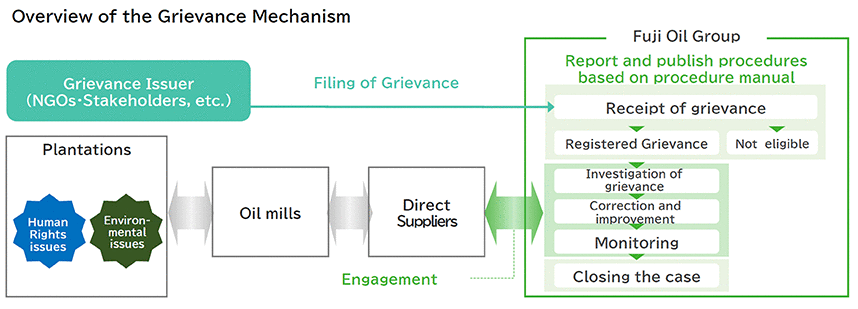
We established a grievance mechanism* in May 2018 in order to enhance the transparency and effectiveness of our Responsible Palm Oil Sourcing Policy.
In FY2025, we will consult with industry stakeholders and experts, and plan to make updates to further enhance its effectiveness. The grievance mechanism allows any stakeholder to raise concerns ― through the Fuji Oil Group Grievance Mechanism webpage (in English) ― regarding environmental, human rights, or other issues related to the Fuji Oil Group and our supply chain, without fear of retaliation or negative consequences.
This enables us to effectively involve stakeholders and appropriately take corrective actions in accordance with our Responsible Palm Oil Sourcing Policy.
Every quarter we report all the grievances we receive and our progress in addressing them via the grievance list posted on the Fuji Oil Co., Ltd. website. In FY2024, we registered 79 grievance cases*1 (76 environmental and three social). Of these, 19 have been resolved, 31 are under monitoring, and 29 have been found to be invalid.
We regularly review our grievance mechanism with the help of experts, and are striving to obtain the necessary and vital information to address the concerns of all stakeholders.
We strongly believe these efforts will lead to a fair, just and transparent resolution of activities suspected of violating our Responsible Palm Oil Sourcing Policy.
*1 The number of grievances that were determined to be directly or indirectly related to the Group’s palm oil supply chain in accordance with the Group’s grievance procedures and do not conform to the Group’s Responsible Palm Oil Sourcing Policy.
* https://www.fujioil.co.jp/en/sustainability/grievance_mechanism/
APT Landscape InitiativeGRI: 304-3
Indonesia: Aceh Landscape Initiative (Location/scope: Aceh, Indonesia)
Since 2018, our Group has been supporting a landscape initiative in the Aceh province of Indonesia, in cooperation with the non-profit Earthworm Foundation.
The program strives to maintain a balance within the region in terms of palm oil production, forest conservation and good social and labor practices.
Aceh is home to the Leuser Ecosystem, which is considered by many scientists and conservation activists to be one of the most biologically diverse places on Earth.
However, deforestation has been continuing in this region due to oil palm plantation development and other activities. Even today, it is still at risk of deforestation. The program requires collaboration among key stakeholders within the landscape, including the private sector, the public sector, farmer cooperatives, local communities, and civil society. The landscape also covers approximately 2.3 million hectares of land across Aceh Selatan, Aceh Tenggara, Aceh Singkil and Subulussalam.
The following are the program’s actions in 2024:
- The district government authorities of Subulussalam (2023), Aceh Singkil (2024) and Aceh Selatan (2024) formally adopted a regional action plan for sustainable palm oil (RAD-KSB).
- Ordinances were enacted by 12 villages to protect a total of 26,244 hectares of forests.
- Local organizations reforested 274 hectares.
- Six companies successfully acquired Indonesia Sustainable Palm Oil (ISPO) certification. There were positive impacts for 2,248 employees by providing childcare facilities, issuing pay slips, improving housing, providing personal protective equipment (PPE) and introducing a waste management system.
As we enter the final year of the five-year plan (2020-2025), we are discussing the second phase (2026-2030).
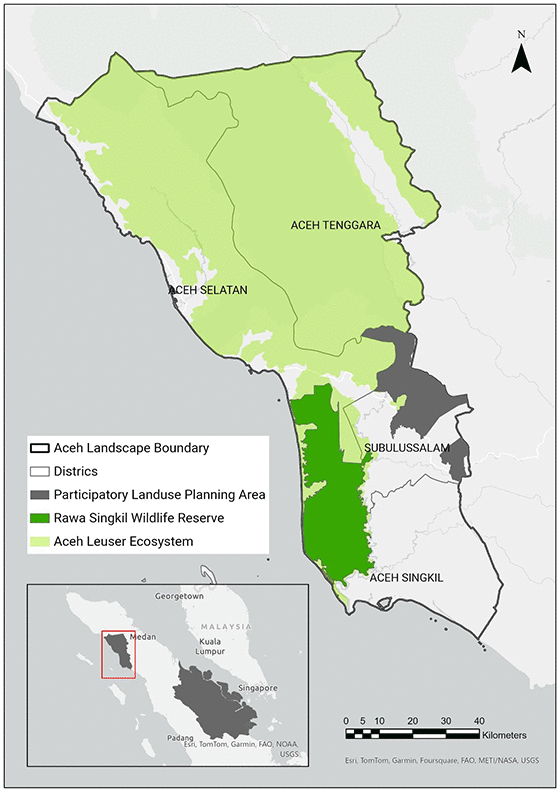
Areas of landscape initiative
Malaysia: Southern Central Forest Spine (SCFS) Landscape program(Location/scope: SCFC, Malaysia)
From 2022, in collaboration with the non-profit Earthworm Foundation, our Group has also been participating in a landscape initiative in the Southern Central Forest Spine (SCFS), our primary palm oil procurement region located in Penninsular Malaysia. Palm oil companies operating in the SCFS landscape*1 are located adjacent to remaining fragmented forest areas within the SCFS that serve as critical wildlife corridors. By working with various stakeholders in SCFS, this initiative aims to promote sustainable practices within the landscape crucial to palm oil industries, including achieving 100% TTP in collaboration with intermediaries in the supply chain known as FFB dealers,*2 improving labor practices, and supporting human–wildlife coexistence in and around oil palm plantations.
Below is our progress in FY2024:
- We engaged with key government agencies and industry associations to improve TTP data flow efficiency through the platform in Malaysia. The rate of deforestation by companies and local communities decreased by 75%.
- Sungai Ara Plantation Cooperative (KPSA) and Federal Land Consolidation and Rehabilitation Authority (FELCRA) installed eight early warning system units to detect elephant intrusions onto small plantations, enabling patrol teams to respond quickly and guide elephants back to their habitats.
- A total of 5,834 workers were engaged in various work initiatives focused on ethical employment and the transformation of labor practices.
In FY2025, as we enter the final year of the five-year plan (2020-2025), we are discussing the second phase (2026-2030).
- *1 https://www.earthworm.org/our-work/projects/scfs-malaysia
- *2 FFB dealers: Companies that act as intermediaries between smallholders and oil mills, providing land management support to smallholders and selling fresh fruits bunches (FFB) to oil mills
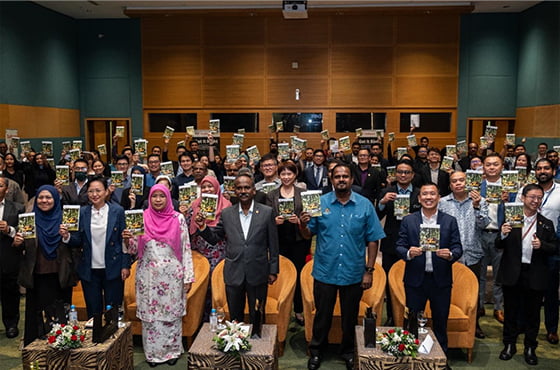
Photo: Bejay Yapp/Earthworm Foundation
Prototype early warning system installed with electric fence of Sungai Ara Plantation Cooperative (KPSA)
Metrics and targets
:At least 90% complete :At least 60% complete :Less than 60% complete
| Medium- to long-term goals | KPI | FY2024 Goals | FY2024 Results | Self-assessment | |
|---|---|---|---|---|---|
| 2030 | 2025 | ||||
| No Deforestation, No Peatland Development and No Exploitation (NDPE) |
Traceability to mill (TTM): 100% | TTM:100% | TTM:100% | TTM: 100% achieved | |
| Traceability to plantation (TTP): 100% | TTP:85% | TTP:85% | TTP: 95% achieved | ||
| N/A | N/A | Continue conducting constant monitoring using satellite images to identify, observe, verify and eliminate deforestation in the palm oil supply chain | Continued partnership with satellite monitoring company to monitor deforestation in the palm oil supply chain | ||
| Deforestation and Conversion Free (DCF) | 100% | N/A | 93.65% | N/A | |
| Labor Transformation Program (LTP) implementation rate: 100% (all direct suppliers) | LTP implementation rate: 100% (all suppliers of Palmaju Edible Oil Sdn. Bhd. (Malaysia))* | Implement LTP at suppliers of Palmaju Edible Oil Sdn. Bhd. (Malaysia): 80% | 83% | ||
-
* An oils and fats manufacturer wholly owned by the Fuji Oil Co., Ltd.
Analysis
Based on our Responsible Palm Oil Sourcing Policy, the Group set a target in 2016 to realize 100% TTM by 2030. We achieved this target in 2019, and continued to maintain it throughout FY2023.
We also implemented a procedure to ensure TTP across our entire supply chain. While there are various challenges such as information confidentiality and supply chain complexities, including procurement from FFB dealers, we are working with a number of experts and consultants to enhance our strategies for improving our Group’s TTP performance and achieve 100% TTP.
For the Labor Transformation Program (LTP), we were able to start conducting site visits again, which had been temporarily suspended due to COVID-19. We exceeded our target as a result of resuming in-person visits and consultations with suppliers. Going forward, we plan to change the name of the program to the Supply Chain Transformation Program and carry out a wide range of initiatives that include improvements in other areas aside from working environment.
The challenge for smallholders, who account for around 30-40% of the entire palm oil production, is that they lack information on sustainable farming techniques and environmental considerations, as well as the funds to implement sustainable practices.
To support these smallholder farmers, since January 2016 we have been participating in the Wild Asia Group Scheme (WAGS)* under Wild Asia, a Malaysian social enterprise, and have been supporting a certification program and WAGS BIO (regenerative farming) programs in Sabah (eastern Malaysia). Through participation in WAGS, we help smallholders improve their farming practices and comply with RSPO and MSPO to address the challenges faced by smallholder palm oil farmers. There are still many issues left to address, including deforestation, land rights, and workers’ rights. It is vital for us to increase our momentum and enhance public awareness of these issues as we work as a Group to strengthen our procurement strategy and improve our supply chain practices.
Next steps
Continued efforts toward NDPE are crucial for realizing sustainable procurement of palm oil. To address this issue, we set the following goals for FY2025 as a continuation of the previous year:
- TTM: 100%
- TTP: Over 95%
- Continue constant monitoring using satellite images to identify, observe, verify and eliminate deforestation in the palm oil supply chain
- Supply Chain Transformation Program at suppliers of Palmaju Edible Oil Sdn. Bhd. (Malaysia): 90%
Specific initiatives
Promoting certified palm oil(Location/scope: The Group’s palm oil supply chain)
In 2024, 63% of the palm oil procured by the Group was RSPO-certified.*1 The growing demand for sustainable palm oil has been a major contributing factor to the increase in the Group’s procurement volume of certified palm oil.
The Unifuji (Malaysia), a joint venture with United Plantations Berhad, a Malaysia-based oil palm plantation company, has maintained its production capacity, enabling us to secure enough palm oil supply to meet the demand in this growing market.
In addition, JPG Fuji Sdn. Bhd., a joint venture between our Group company Fuji Oil Asia Pte. Ltd. (Singapore) and Johor Plantations Group Berhad (Malaysia), a palm oil and palm kernel manufacturer, is scheduled to start operation in FY2026. JPG Fuji Sdn. Bhd. is expected to be fully RSPO-certified, with a simple and traceable system that will enable it to serve markets such as Europe that demand high-quality raw materials.
Our Group has implemented the RSPO’s new Shared Responsibility (SR) rules and expanded the volume of certified palm oil we procure every year. However, we have been facing challenges in recent years, such as the fact that certified palm oil supply exceeds demand, and that acquiring certification is difficult for smallholders. Increasingly stringent sustainability requirements limit palm oil expansion and increase the reliance of smallholder farmers on RSPO certification. In this context, we are proactively supporting smallholder farmers to obtain RSPO certification, especially those in our palm oil supply chain. Since 2021, we have been actively participating in RSPO working groups to discuss these issues and reflect them in the development of solutions.
Going forward, we plan to step up efforts to meet even more customer requests, particularly in the European market where demand is increasing, by deepening our partnership with Johor Plantations Group Berhad in Malaysia,*2 a strategic supplier of Palmaju Edible Oil Sdn. Bhd. (Malaysia).*3
- *1 Roundtable on Sustainable Palm Oil (RSPO)
-
*3 For RSPO’s progress, see:
What is RSPO certification?
RSPO certification is a widely-recognized international certification system in the palm oil industry. The Group has been a member of Roundtable on Sustainable Palm Oil (RSPO) since 2004, supporting the establishment of a certification system for the sustainable production and consumption of palm oil. RSPO is a non-profit organization that brings together stakeholders from seven sectors of the palm oil industry to develop and implement global standards for sustainable palm oil. They include a set of environmental and social standards that member companies must comply with in order to produce certified palm oil. When properly applied, these standards can minimize the negative impacts of palm cultivation on the environment and communities in palm oil-producing regions.
What is Shared Responsibility (SR)?
SR is the set of responsibilities adopted by RSPO members to achieve RSPO’s vision, a global partnership to make palm oil sustainable. The supply of RSPO-certified sustainable palm oil accounts for only about 19% of the global supply. All RSPO members ― including supply chain stakeholders, investors, and NGOs ― have a role to play in increasing both the production and uptake of certified sustainable palm oil, and in making it the preferred choice. The Fuji Oil Group is committed to increasing the share of RSPO-certified palm oil in its supply chain by 2% each year, as sought by RSPO.
Collaboration with NGOs and industryGRI: 304-3
(1) Supporting smallholders in Sabah, Malaysia
Since January 2016, our Group has joined the Wild Asia Group Scheme (WAGS),*1 managed by the Malaysian social enterprise Wild Asia, and supported its certification program and WAGS BIO regenerative agriculture program being conducted in the state of Sabah in eastern Malaysia. Small and medium-sized operations account for the majority of oil palm plantations. Low productivity of plantation management by some operations at this scale has been identified as one factor behind environmental and human rights issues related to the procurement of palm oil. Through its participation in WAGS, the Group is working to address challenges faced by palm oil smallholders, by helping them improve their farming practices and comply with standards such as those of RSPO and MSPO.
The certification support program provides smallholders with the technical support and training for acquiring RSPO certifications. Since we joined the program in January 2016, the Group has helped a total of 1,633 smallholders to obtain the certification through WAGS (as of March 2025).
The WAGS BIO program supports farmers to introduce regenerative agriculture with the goal of raising smallholders’ income, mitigating their adverse impact on biodiversity, and conserving and restoring natural ecosystems around plantations. In FY2024, we continued to conduct training on regenerative farming methods and intercropping of ginger and other cash crops. The total number of plantations that meet the BIO farm standard through pesticide-free farming and other methods has reached 94 (as of March 2025). In another initiative, we provided training to farmers on producing biochar from oil palm leaves. The application of biochar is expected to improve soil quality, and the carbon stored in the soil should have a mitigation effect on climate change.
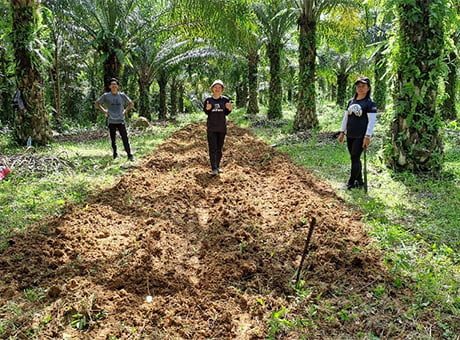
Engagement with new BIO farmers
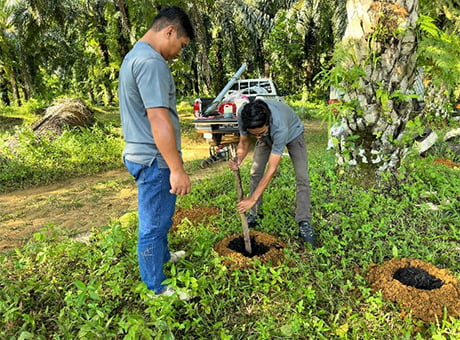
Planting medicinal trees (Mas Cotek*2) in a plantation
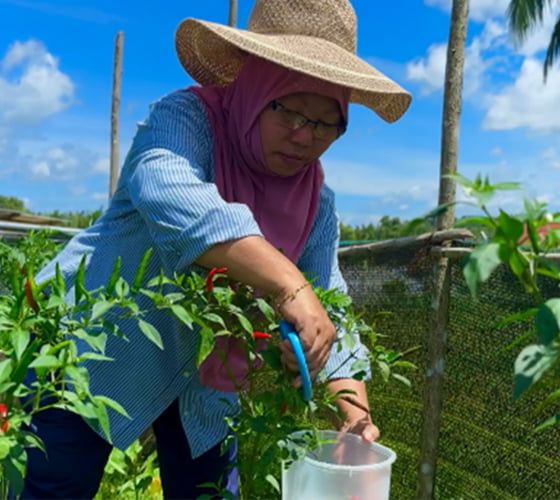
Harvesting chili peppers in a BIO plantation
- *1 Wild Asia Groups Scheme (WAGS): A program aimed at smallholders and independent producers in Malaysia to support sustainable palm oil production.
- *2 Mas Cotek: A medicinal plant that grows in Malaysia. In English often referred to as mistletoe fig.
(2) The Palm Oil Working Group, the Japan Sustainability Local Group of the Consumer Goods Forum
Our Group has been a member of the Consumer Goods Forum (CGF), an international industry organization for consumer goods distribution, and we have participated in the Japan Sustainability Local Group since its inception in November 2017. We have been active in its steering committee and Palm Oil Working Group.
(3) Japan Sustainable Palm Oil Network
Fuji Oil Co. Ltd. has been a full member of the Japan Sustainable Palm Oil Network since October 2019, in support of its aim of promoting sustainable palm oil procurement and consumption throughout the Japanese industry.
(4) Palm Oil Collaboration Group
Since June 2020, Fuji Oil Group has been participating in the Palm Oil Collaboration Group (POCG),* which brings together companies from every stage of the palm oil supply chain with the aim of accelerating effective action toward NDPE commitments. Currently, we are an active member of the Social Issues Working Group, which discusses and resolves human rights issues. We will continue participating in and contributing to the Working Group to develop effective solutions to achieve NDPE, with a focus on the following priorities:
- Human rights due diligence in management systems
- Responsible recruitment in Malaysia’s palm oil industry, which is predominantly made up of migrant workers
- Protecting the rights of Indigenous Peoples and local communities