
Director Remuneration
Policy for the Remuneration for Directors and the calculation
We stipulate the policy for determining the amount of remuneration for Directors and the method of calculation.
- a. Remuneration for Directors (Excluding Audit and Supervisory Committee Members)
- We have introduced a performance -linked remuneration plans for directors (excluding Audit and Supervisory Committee Members). The plans aim to clarify the linkage among the remuneration for directors, corporate performance and stock price. They allow directors to share with the shareholders the benefits and risks of stock price fluctuations, then to raise the awareness for improving the mid to long- term corporate performance and increasing the corporate value.
- Basic Policy of remuneration structure
-
- Share value with shareholders and other stakeholders.
- Raise awareness to improve mid- to long-term performance and to increase corporate value.
The amount and its calculation of the remuneration for directors in the fiscal year are determined as of the date of the submission of the Annual Securities Report by the Board of Directors within the range of the total amount approved at the General Meeting of Shareholders. The determination is made upon consulting with and making a report to the Nomination and Compensation Advisory Committee (NCAC) of which Outside Directors account for the majority of its members. NCAC deliberates the total amount of remuneration to Directors, the method of calculation and the performance-linked coefficients. NCAC then reports its findings to the Board of Directors.
- Remuneration Structure
-
The remuneration structure for directors (excluding Outside Directors, and Audit and Supervisory Committee Members) consists of basic remuneration (fixed amount, based on position), performance-linked cash remuneration (bonus) and stock-based remuneration (Board Benefit Trust).
Amounts of remunerations for directors are reported to the Board of Directors upon deliberations by NCAC taking into account of the industry peer group benchmarking and of remuneration survey data by external institutions.
Considering directors roles and ensuring objectivity, remuneration to Outside Directors consists only of basic remuneration (fixed remuneration).
(i) The basic remuneration (fixed remuneration) is paid monthly for the role.
(ii) The performance-linked cash remuneration (bonus) is determined based on single-year company performance, using as financial KPIs “Net income attributable to owners of the parent company,” “Consolidated business profit,” and “FUJI ROIC”*1, and using the overall company score of the engagement survey as a non-financial KPI, and is designed to vary from 0% to 200% in accordance with the degree of achievement.
(iii) Performance-linked Share-based remuneration (Board Benefit Trust) is to be calculated according to the annual targets of EPS (consolidated net income per share) and ROE (consolidated return on equity) outlined in the Mid-Term Management Plan as KPIs. The amount is to be paid out at a rate between 0% and 200%. Furthermore, the vesting timing to Directors is at the retirement from the position of Director. This serves as a mid to long-term incentive because the value of assets fluctuates accordingly with the stock price during the terms of office of those Directors.
- *1: FUJI ROIC = Business profit after tax / (Working capital + Fixed assets + Equity method investments)
We consider performance-linked remuneration ratio should increase in conjunction with the growth of corporate performance and value. We expect ratio for future remuneration is as follows:-Basic remuneration: Cash remuneration (bonus) : Share-based remuneration = 1 : 1 : 1
(Performance-linked Cash Remuneration in FY2025:KPI Performance)
KPI FY2025
TargetFY2025
ResultPerformance-linked Coefficient Cash remuneration (bonuses) financial KPI Net income attributable to owners of the parent company 16.5
billion yen11.142
billion yen0.77 Consolidated business profit 29.5
billion yen36.048
billion yenFUJI ROIC 4.5% 5.1% non-financial KPI the engagement score 70pt 69pt share-based Remuneration
(Board Benefit Trust)financial KPI EPS
(consolidated net income per share)191.92 yen 129.60 yen 0.33 ROE
(consolidated return on equity)More than
5%5.0% - (Note) Since the consolidated ROE is less than 5%, the calculated performance-linked coefficient reflects a 10% reduction.
(Reasons for KPI selection)
KPI Reasons for selection Cash remuneration
(bonuses)financial KPI Net income attributable to owners of the parent company Clarification of accountability for profit after tax representing corporate performance Consolidated business profit Enhancement of profitability and business soundness through business activities, and capacity enhancement to generate funds for reinvestment FUJI ROIC Achievement of mid to long-term improvement of profitability, with efficiency improvement of capital investment non-financial KPI the engagement score Development of the results in the promotion of the group unification (DE&I) based on ESG materiality share-based Remuneration
(Board Benefit Trust)financial KPI EPS
(consolidated net income per share)Clarification of accountability for results against the targets set for the base remuneration ROE
(consolidated return on equity) - b.Remuneration System for Audit and Supervisory Committee Members
- Considering their roles and ensuring objectivity, remuneration to Audit and Supervisory Committee Members is comprised only of basic remuneration. Remuneration amounts are determined based on deliberation in the audit and supervisory committee up to a maximum remuneration amount determined via resolution at the General Meeting of Shareholders. Furthermore, we refer to survey data by external institutions.
Total Amount of Remuneration by Position, Total Amount by Type of Remuneration, and Number of Eligible Recipients
| Position | Number of eligible recipients (persons) |
Total amount by type of remuneration (millions of yen) |
Total amount of remuneration (millions of yen) |
||
|---|---|---|---|---|---|
| Fixed remuneration | Performance-linked remuneration | ||||
| Cash remuneration (bonuses) |
Share-based remuneration (Board Benefit Trust) |
||||
| Directors (excluding outside directors and Audit and Supervisory Committee Members) |
4 | 114 | 52 | 20 | 187 |
| Audit and Supervisory Committee Members (excluding outside directors) |
1 | 25 | - | - | 25 |
| Outside directors | 8 | 70 | - | - | 70 |
| Total | 13 | 209 | 52 | 20 | 282 |
(Note)
- 1
- The above amount includes remuneration for 2 Directors who stepped down from their positions upon the adjournment of the 97th Ordinary General Meeting of Shareholders held on June 27, 2025.
- 2
- The total amount of remuneration of directors excludes the portion of employee remuneration for directors who concurrently serve as employees.
- 3
- At the 94th Ordinary General Meeting of Shareholders held on June 21, 2022, the amount of remuneration for directors was determined not to be more than 600 million yen per year (of which, the amount of remuneration for outside directors was not to be more than 100 million yen per year) before the transition to a company with an Audit and Supervisory Committee. Meanwhile, the maximum amount of remuneration for directors (excluding outside directors) includes director bonuses and does not include the portion of employee remuneration. The number of directors as of the conclusion of the 94th Ordinary General Meeting of Shareholders was nine (five of whom were outside directors).
- 4
- The above includes performance-linked cash remuneration (bonus) for this fiscal year.
- 5
- We have introduced the Performance-linked Share-based Remuneration Plan (Board Benefit Trust: BBT) as a non-monetary compensation for Directors (excluding Audit and Supervisory Board members, and Outside Directors). At the 94th Ordinary General Meeting of Shareholders held on June 21, 2022, the amount of the compensation was determined not to exceed a total of 600 million yen.
The compensation can be made in the form of funds to acquire the Company’s shares necessary for issuance of BBT to eligible directors during the three-year period which can be extended up to five business year at the necessary time in accordance with the determination by the Board of Directors. The number of directors (excluding outside directors, and Audit and Supervisory Committee Members) as of the conclusion of the 94th Ordinary General Meeting of Shareholders was four. - 6
- Amount of performance-linked remuneration (BBT) explains the expense in the fiscal year under the Performance-linked Share-based Remuneration Plan determined at the 94th Ordinary General Meeting of Shareholders held on June 21, 2022.
- 7
- At the 94th Ordinary General Meeting of Shareholders, the maximum amount of remuneration for Audit and Supervisory Committee members was determined not to be more than 100 million yen per year. The number of Audit and Supervisory Committee members as of the conclusion of the 94th Ordinary General Meeting of Shareholders was three.
Director Remuneration System for fiscal 2026
There will be three directors subject to the performance-linked remuneration system for directors in the fiscal year 2026.
- (Performance-linked Remuneration for Directors)
- The following gives an overview of the details of the variable remuneration for Directors – performance-linked cash remuneration (bonus) and performance-linked share-based Remuneration.
- a. Performance-linked Cash Remuneration (Bonus)
-
The performance-linked cash remuneration (PLCR) (bonuses) adopts consolidated business profit for a single fiscal year as a performance indicator based on the improvement of corporate performance, and the base remuneration amount is automatically determined once the consolidated business profit is determined.
The performance-linked coefficient is calculated by weighing the degree of achievement against the company's performance index for the relevant fiscal year.
The company performance indicators used in the calculation are “Net income attributable to owners of the parent company,” “Consolidated business profit,” and “FUJI ROIC ”*1 as financial KPIs, and the overall company score of the engagement survey as a non-financial KPI.
Each KPI will be weighted:-
50% for “Net income attributable to owners of the parent company”
20% for “Consolidated business profit”
20% for “FUJI ROIC” and
10% for the engagement score.
The amount of PLCR will be determined based on the performance of the relevant fiscal year and paid in the following fiscal year; therefore, the amount of the remuneration based on the performance of fiscal year 2026 will be paid in fiscal year 2027.
The amount to be paid to each director will be determined by the following formula.- *1: FUJI ROIC = Business profit after tax / (Working capital + Fixed assets + Equity method investments)
Individual amount of payment = Target amount of remuneration by position (i) × performance-linked coefficient (ii)
- (i) Target amount of remuneration by position
-
We will set the consolidated operating profit of 37.5 billion yen as the target KPI in FY2026. The amount of remuneration when the target KPI is achieved 100% is as follows.
Position Target Remuneration (million yen) Eligible directors (persons) President and
Representative Director42 1 Directors 25.5 2 - (ii) Performance-linked coefficient
-
(Performance-linked Coefficient Calculation Method)
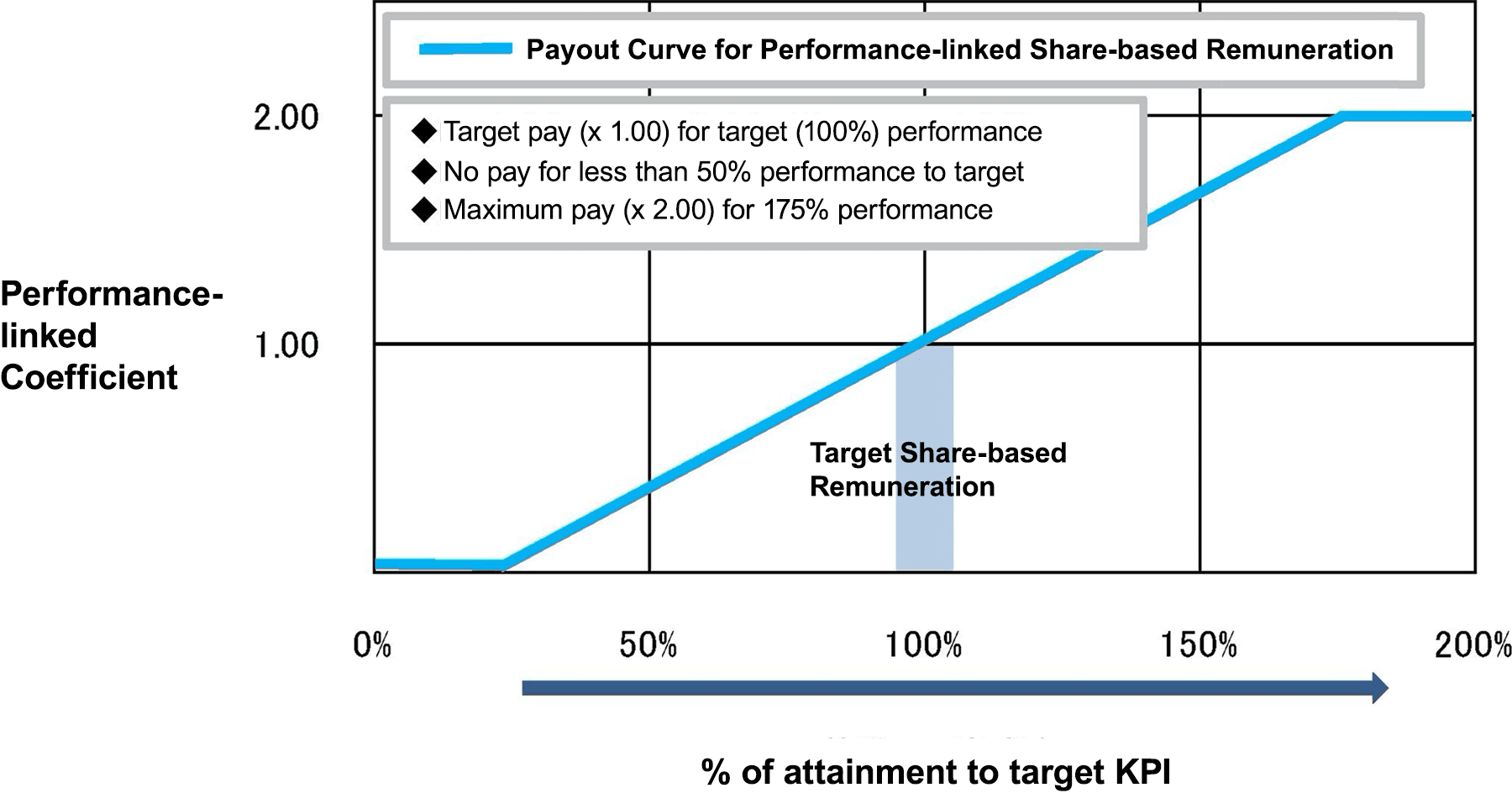
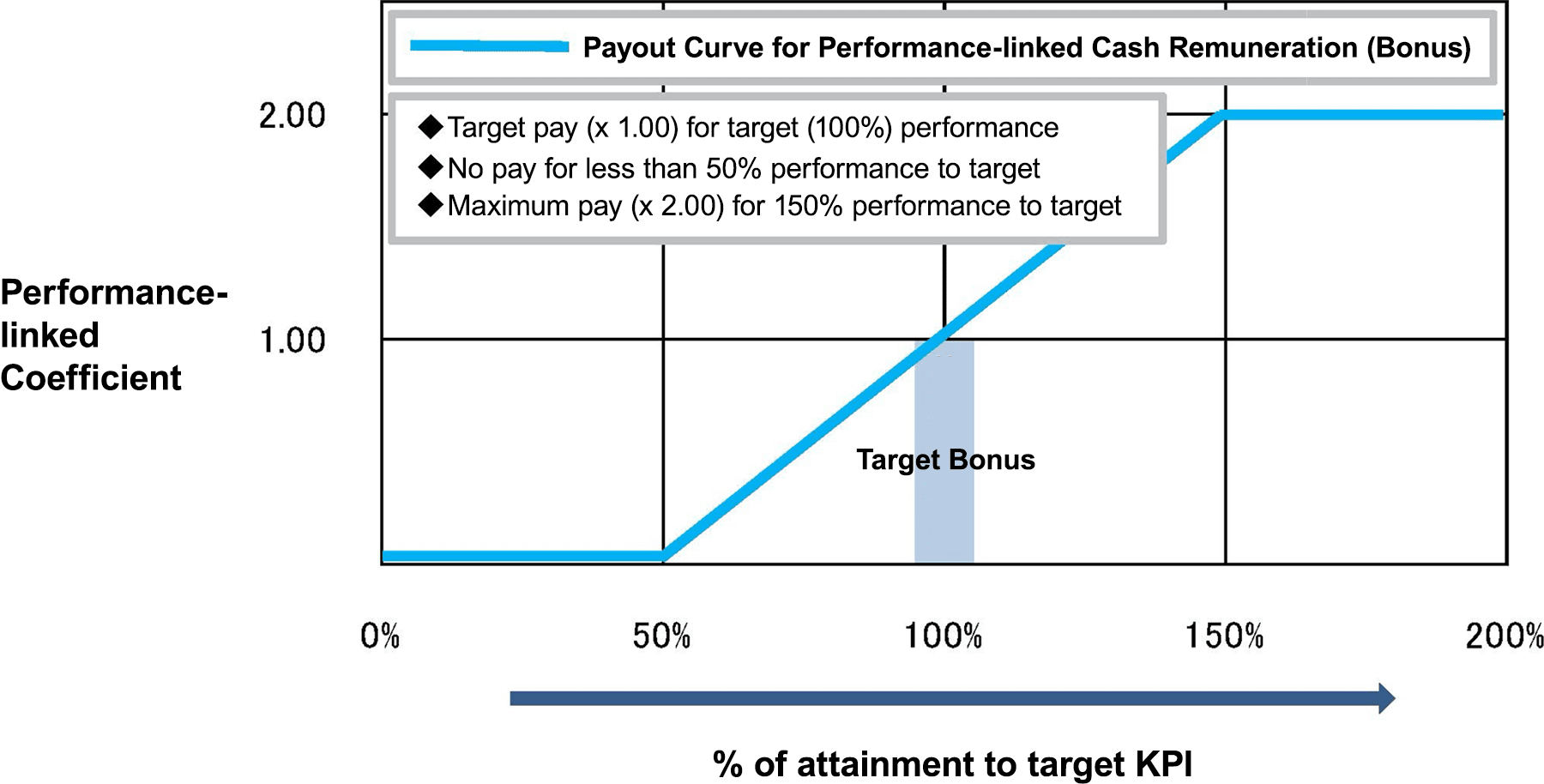
KPI achievement rate Performance-linked coefficient 150% or over 2.0 50% or over but less than 150% ((Fiscal year KPIs x each weight) – 50%) × 2.0 (Rounded up at the third decimal place)
* Weight-average of the percentage of each achieved KPI.Less than 50% 0 - KPI Achievement Rates and Weights:
- Financial KPIs
- -Profit attributed to owners of parent: 50%
- -Consolidated business profit: 20%
- -FUJI ROIC* : 20%
- Non-Financial KPI
- -Employee engagement score: 10%
- Calculation formula for KPI achievement rate:
- KPI achievement rate = Result KPI / Standard KPI × 100
- Result KPI = Result value for each KPI in the applicable fiscal year
- Standard KPI = Reference value set for each KPI in the applicable fiscal year
[Image of Payout Curve in Performance-linked Coefficients]
- (iii) Handling If Directors Are Newly Appointed during the Applicable Period
-
If a director is newly appointed during the applicable period, the individual amount to be paid to the said Director will be in proportion to the number of months they serve in office. If the Director is newly appointed partway through a month, we assume he has been in office for the full month.
Proportional ratio = Total number of months served in office / Total number of months of the applicable period
- (iv) Handling If Directors Retire (Including the case of decease) during the Applicable Period
-
If a director retires (including the case of decease) during the evaluation period, the individual amount will be obtained by multiplying 80% to the target amount of remuneration for Directors, however, it will be in proportion to the number of months they serve in office. If a Director retires partway through a month, we assume the said Director has been in office for the full month. However, if a Director is dismissed based on disciplinary action due to misconduct, the payment ratio shall be 0%.
Proportional ratio = Total number of months served in office during the applicable period / Total number of months of the applicable period
- (v) Handling if the Position of a Director Changes during the Applicable Period
-
If the position of a Director changes during the applicable period, we shall pay the said Director the individual amount of payment according to his/her position as of the end of the fiscal year (the end of March).
- b.Performance-linked Share-based Remuneration Plan
-
The performance-linked share-based Remuneration system (hereinafter “the System”) further clarifies the linkage among the remuneration of Directors, the performance and stock price of the Company. The objective is to raise awareness to improve mid- to long-term performance and to increase corporate value, and is for directors to share with shareholders benefits and risks of fluctuations of the stock price. In addition, we employ single-year EPS (consolidated net income per share) and consolidated ROE as the KPIs to raise awareness for improving corporate performance each fiscal year and to further share value with stakeholders.
The System is a share-based Remuneration system. A trust established by the Company through contribution of money (hereinafter “the Trust”) acquires shares of the Company. The share is equivalent to the points awarded by the Company to the directors (one share counts for one point). The equivalent shares of the Company is given to the directors through the Trust. Moreover, in principle, directors receive shares of the Company at time of retirement. The number of points awarded to directors is determined by the performance (consolidated EPS and consolidated ROE) in a fiscal year. The number of points is finalized in the fiscal year of the directors retirement, on the date when performance-linked indicators fix.The upper limit of the money that the Company contributes to the Trust is 200 million yen per fiscal year .The upper limit of the total number of points is 100,000 points per fiscal year. The individual points to be awarded to each Director is determined by the following formula.
Individual payment points = Target amount of remuneration by position (i) × Performance-linked coefficient (ii) / Price of shares of the Company acquired by the Trust (iii)
(Decimal point are to be rounded up) - (i) Target amount of remuneration by position
-
We will set the consolidated net profit of 226.79 yen per share as the target KPI in FY2026. The target amount of remuneration when the target KPI is achieved 100% is as follows.
Position Base Remuneration (million yen) Eligible directors(persons) President and Representative Director 33.8 1 Directors 20.6 2 - (ii) Performance-linked coefficient
-
(Performance-linked Coefficient Calculation Method)
KPI achievement rate Performance-linked coefficient 150% or over 2.0 50% or over but less than 150% (Result KPI / Target KPI – 0.5) × 2.0
(Round up at the third decimal point)Less than 50% 0 - KPI achievement rate=Result KPI / Target KPI×100
- Result KPI=Result consolidated net income per share in the applicable fiscal year
- Target KPI=Target consolidated net income per share in the applicable fiscal year
In cases where consolidated ROE is 5% or less, the Performance-linked Coefficient is reduced by 10%.
[Image of Payout Curve in Performance-linked Coefficients]
The upper limits of the points to individual director (1 point = 1 share) are as follows.
President and Representative Director: 25,000 points
Directors: 12,500 points - (iii) Price of shares in the Company acquired by the Trust
-
Regarding the stock incorporated to the Trust, the Board of Directors votes on the acquisition method, volume and prices. The information shall be disclosed externally on the day of the stock acquisition. While there are two methods of acquiring stock, the disposal of company’s treasury shares or acquisition through a stock exchange (including after-hours trading), the price of stock incorporated to the Trust will be one of the following:-
For disposal of company’s treasury shares:
The closing price of Company stock at the Tokyo Stock Exchange on the business day immediately prior to the Board of Director’s meeting convened to vote on third-party allocation.For acquisition through a stock exchange:
Actual price of Company stock purchased in the market after a resolution by the Board of Directors concerning the acquisition of stock.Furthermore, for the calculation of points allocated to individual director, the stock price shall be the average price of retained stock at the time of points allocation by the Trust.
- (iv) Handling If Directors Are Newly Appointed during the Applicable Period
-
When we appoint new Directors during the applicable period, the individually granted points to Directors are to be proportionally divided by the number of months they serve in office. If a Director is newly appointed partway through a month, we will calculate the grant assuming the said Director has been in office for the full month.
Proportional ratio = Total number of months served in office during the applicable period / Total number of months of the applicable period
- (v) Handling If Directors Retire (Including the case of decease) during the Applicable Period
-
We shall grant the points to Directors who retire (including the case of decease) during the period in proportion to the number of months they serve in office, however, the amount will be obtained by multiplying 80% to the target amount of remuneration for Directors. If a Director retires partway through a month, we shall calculate the grant assuming the said Director has been in office for the full month. However, if a Director is dismissed based on disciplinary action due to misconduct, the grant ratio shall be 0%.
Proportional ratio = Total number of months served in office during the applicable period / Total number of months of the applicable period
- (vi) Handling If the Position of a Director Changes during the Applicable Period
-
If the position of a Director changes during the applicable period, we shall grant the said Director the individually granted points according to his/her position as of the end of the fiscal year (the end of March).
- (vii) Handling of Conversion into Cash
-
If the relevant director who is a non-resident resigns or retires due to death, the company shall, in lieu of delivering the company's shares, provide the relevant director with an amount of money equivalent to the market value of the shares that would have been delivered.
- c.Remuneration composition
-
When performance-linked coefficients are all 1.0 in the FY2026 target KPI, remuneration compositions are as below.
Position Basic remuneration
(fixed remuneration)Performance-linked
cash remunerationPerformance-linked
share-based Remuneration
(Board Benefit Trust)President and
Representative
Director42% 32% 26% Directors 42% 32% 26%
Corporate Governance
Group Governance